Rome Travel Itineraries
General
"All roads lead to Rome and perhaps, in Rome we shall meet... there we will stroll in the shadow of the cathedral, St. Peter's Square of the Vatican, the Pope and all the cardinals do not even dream that we are here..." (All Roads Lead to Rome, Hanna Maron and Yossi Dayan).
Rome is all of that, and much more. Rome is beauty, romance, culinary arts, culture, religion, art, splendor, architecture, shopping, vibrancy, and much more. The city center of Rome is spread across seven hills east of the Tiber River, along both banks of which the city extends. Among the hills, which form the heart of the city, you will find the Capitoline Hill and the Palatine Hill, where according to tradition, the brothers Romulus and Remus founded Rome.
It is recommended to visit Rome for at least 3-4 days. This duration allows you to reach all the famous tourist sites, while also discovering other charming points of interest, alongside, of course, delicious meals filled with plenty of pizza, pasta, cheeses, gelato, and wine.
Accommodation in Rome
In Rome, it is best to stay in the city center, close to all the attractions. There is no need for a rental car; you can get around by public transportation and taxis, avoiding the hassle of expensive parking. Here are several great accommodation options in central Rome:
♦ Recommended Hotels in Central Rome:
In Piazza Navona:
Hotel - Hotel Lunetta
A 4-star hotel 100 meters from Piazza Navona. Spa included in the price. Air-conditioned rooms. Free Wi-Fi. Paid parking.
Adjacent to Piazza Navona. Air-conditioned rooms. Free Wi-Fi. Street parking. Family suite also available.
Suites Hotel:
Piazza Farnese Luxury Suites
A suites hotel for 5-6 guests. Air-conditioned. Located right next to the Campo de' Fiori market, a few minutes' walk from Piazza Navona. Free Wi-Fi. No parking.
Near the Vatican:
Rooms and suites hotel - Starhotels Michelangelo Rome
A 4-star hotel. Air-conditioned rooms for 2-4 guests. Free Wi-Fi in some rooms. Paid parking nearby.
Search for Hotels on Booking.com on the Rome Map:
Booking.com
Guided Tours and Transfers in Rome
You can certainly explore Rome independently and enjoy the sights, restaurants, etc. However, for those who want guided tours to add interest, explanations, and historical background, it is recommended to take one of the following suggested guided tours. Options include walking tours, bicycle tours, or Segway tours. For Italian food lovers, culinary tours are also available.
♦ Private Transfer from Rome Airport to Hotel or Vice Versa:
Rome Airport Transfer - ONE WAY
Booking Tours and Attractions for Travelers in Rome:
Transfers and Tours Tailored for Cruise Passengers in Rome - from the Cruise Port in Civitavecchia:
These tours are designed for cruise passengers, departing from and returning to the port. Keep in mind that the port is located about 80 km from the city of Rome.
Private Transfers and Tours from Civitavecchia Port
Rome Itineraries
To reach the city center, a private transfer from the airport is recommended. A reliable and recommended transfer company is www.mudicartransfer.it
Public transportation in Rome is not particularly convenient, so it is recommended to stay close to the city center and walk to the tourist sites.
Each itinerary described below is suitable for a full day on foot. The article incorporates recommendations for excellent guided tour companies of various types, including tours in Hebrew.
Itinerary No. 1
When you say "Rome", you say fountains, magnificent buildings, impressive architecture, history, and religion. On this day, you will be able to discover most of the sites fitting these descriptions, as you tour between the most impressive fountains in the city.

Start your tour at the colorful market, Campo de' Fiori. The market is active and bustling mainly during the morning and early afternoon hours, until 1:00 PM. Here you will find stalls of vegetables, fruits, spices, pastas, flowers, and fresh juices alongside kitchenware and souvenirs. In the past, during the Inquisition, heretics and witches were executed here. Today, in the center of the square stands a statue of a 17th-century philosopher who was deemed a heretic for asserting that the universe is infinite and that our galaxy is only one of many.


From here, proceed with a walking route of about 10 minutes toward the Jewish Ghetto. This neighborhood, once enclosed, is very pleasant to wander through today. You will find numerous restaurants (including kosher options) alongside bakeries and delis. At the heart of the Ghetto lies Via Portico d'Ottavia, a romantic archaeological monument that once served as a fish market.

Near the Ghetto stands the Turtle Fountain, Fontana delle Tartarughe. The fountain features four young men, each with a foot resting on the head of a bronze dolphin. Bronze turtles are also perched around the upper basin, added later during construction. From the fountain, continue a short distance toward Largo di Torre Argentina. This is a ruin site of ancient Roman structures, including a theatre and temples. Animal lovers in general, and cat enthusiasts in particular, are in for a lovely surprise: located on-site is a street cat sanctuary that cares for, treats, and feeds hundreds of stray cats. The sanctuary does noble work and operates without support from the municipality of Rome. If you happen to be in the area, do not miss a visit to this warm and welcoming shelter, and perhaps even leave a modest donation to support their important mission.


From here, head north on a 5-minute walk toward the Pantheon. The Pantheon is considered one of the best-preserved ancient sites in the city, and perhaps in the entire world. The structure was originally built in 27 BC as a temple dedicated to all the gods, and was rebuilt at the beginning of the 2nd century. The name originates from Greek: pan – all, and theon – divine. In 1870, the Pantheon became a memorial church and burial site for the kings of Italy, housing the tombs of several Italian monarchs as well as the artist Raphael, one of the most prominent Renaissance painters. Admission is free.
Don't miss looking up at the extraordinary dome ceiling, at the center of which is an open oculus allowing daylight to stream through.

From the Pantheon, continue toward Piazza Navona. This is the main square of central Rome, located in the heart of the tourist area. The square is built in an elliptical shape and is adorned with breathtaking fountains. It is surrounded by cafes, gelaterias, restaurants, and shops, where prices—reflecting the central location—are higher compared to other neighborhoods. The central monument on the square is the Fountain of the Four Rivers. The fountain symbolizes four continents separated by four major rivers: the Ganges (Asia), the Nile (Africa), the Danube (Europe), and the Río de la Plata (America), portrayed through sculpted marble river gods seated on separate rocks from which each river springs forth. At the center rises an impressive obelisk transferred here from the Circus of Maxentius, symbolizing the triumph of the Church over paganism. Additional fountains on the square include Fontana del Moro and Fontana del Nettuno, where the god Neptune comes alive.


From here, continue on a roughly 15-minute walk toward the wishing well, the Trevi Fountain (Fontana di Trevi). Legend has it that whoever tosses a coin over their shoulder into its waters is guaranteed to return to Rome in the future. Some add that a second coin will make you fall in love with an Italian, while a third will bless you with marriage. Either way, it is fascinating to learn that every day, city municipal workers retrieve approximately €3,000 from the fountain floor!!!
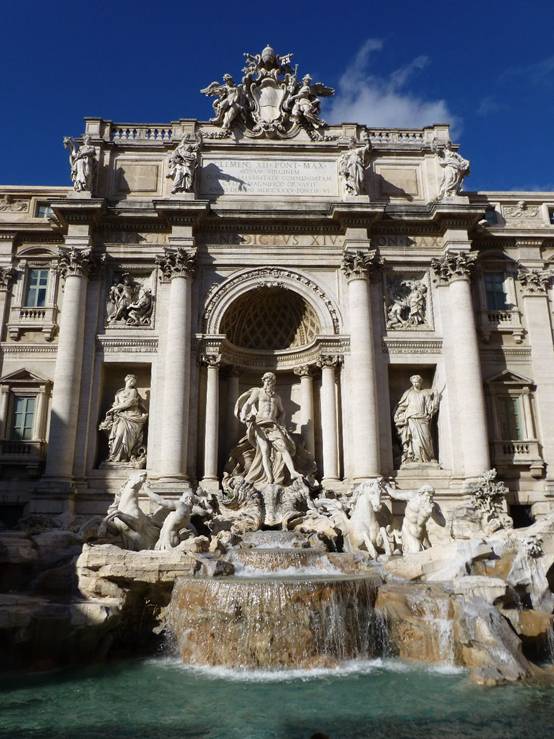
The fountain is impressive both during daylight hours and in the evening when it is illuminated. Throughout the year, you will find hundreds of tourists tossing coins around the fountain, but be sure to also admire the fountain itself and its ornate design. The sculptures showcase the sea god Neptune and the sea horses leading his chariot.
From the fountain, continue with a 10-minute walk toward the Spanish Steps and Piazza di Spagna.
Before reaching the square, you will notice a large fountain located at the foot of the Spanish Steps: the Fountain of the Old Boat, Barcaccia Fountain, designed to resemble a sinking ship.
The Spanish Steps consist of 138 steps leading from Piazza di Spagna up to Trinità dei Monti, a French church situated at the top of the staircase. From the church, you can enjoy a lovely panorama of the fountain and the city, and admire two works of art by Daniele da Volterra, a pupil of Michelangelo. In addition, adjacent to the church is an expansive, pleasant garden that also provides a wonderful viewpoint over the city.
The Spanish Embassy, regarded by some as the oldest embassy in the world, is situated near the steps and gave them their "Spanish" name.

From the Spanish Steps, continue on foot toward the People's Square, Piazza del Popolo. The square is located at the northern end of Via del Corso. It is closely tied to the history of Rome; during the Middle Ages, horse races started here and public executions were carried out. Today, at the center of the square stands an Egyptian obelisk dating from the era of Ramesses II, around the 13th century BC. The obelisk is inscribed with hieroglyphs depicting the life and reign of the Egyptian pharaoh.

From the square, continue a 20-minute walk southeast toward the final stop of the tour: Piazza Venezia. The square lies at the foot of the Capitoline Hill, right next to the Roman Forum, the old heart of the city. The square is bustling and expansive, packed with tourists, cars, street artists, and shops. In its center, you cannot miss the massive marble monument, the Vittoriano. This impressive structure was built in memory of the first king to rule a unified Italy, King Vittorio Emanuele II. Inaugurated in 1911, it is nicknamed the "Altar of the Fatherland" but has also received harsh public criticism. Critics claimed its construction inflicted irreversible damage on ancient ruins and entirely changed the shape of one of the city's historic hills, the Capitoline Hill.

While the monument is magnificent in itself, it is highly recommended to ascend to the rooftop observation deck for views across the entire area. The viewpoint, Roma dal Cielo, is reached via a glass elevator on the back of the building. Admission is paid, though you can access a lower terrace viewpoint in the structure for free, which also provides breathtaking views. Opening hours are 9:30 AM to 5:30 PM, with last entry at 5:00 PM.
Additionally, overlooking the large square stands Palazzo Venezia, the first Renaissance palace built in the city during the 15th century. Over the years, the palace served as Mussolini's headquarters, and many of the dictator's speeches to the Italian public were delivered from the balcony facing the piazza.


♦ Car rental on the reliable and convenient Booking.com website: Booking.com
Itinerary No. 2
Rome, as noted, is best explored on foot, but a wonderful and recommended option to tour the city without exhausting your legs is a Segway tour. The tour allows you to cover—in a short time—many sites that are difficult to fit into a single walking day. Furthermore, the tour guides know how to lead you to lesser-known hidden gems, introducing you to even more delightful sides of Rome.
Recommended Segway Tour in Rome:
The departure point for tours with the Rome by Segway company is at their offices, located a 5-minute walk from the Colosseum. Due to the proximity to this site, it is recommended to visit the Colosseum and the Roman Forum before or after the Segway tour (depending on the tour you choose). Most tours last about 3.5 hours (including half an hour of practice and training on the Segway), though longer options exist. A particularly recommended route is called Ancient Rome. The tour lasts about 3.5 hours, during which you will get to know fascinating historic sights such as the Palatine Hill, the Roman Forum, and the Colosseum, while hearing many stories about the city's unique history, architecture, art, and local culture. Additionally, experienced guides will take you to lesser-known spots, such as the lovely Knights of Malta keyhole lookout, which offers a breathtaking view framed through a keyhole, as well as a scenic terrace in the Orange Tree Garden park. The Segway tour includes live commentary from the guide along with recorded audio and video explanations played on an iPod device provided by the guide.
The tour is paid, with discounts available for families (parents + child). The tour departs 6 times throughout the morning and afternoon, depending on the season. Tours with Hebrew-speaking guides can also be arranged, subject to a minimum number of participants in the group. Highly recommended and fun!!

Short Video on a Segway Tour in Rome:
Another wonderful experience is an evening Segway tour, where you can see illuminated Rome with its dazzling fountains and squares. This tour is especially ideal during summer, when it is too hot to walk around mid-day under the relentless sun.

Segway Rome Tours offers a 3-hour night tour where you will see Rome lit up in all its glory, accompanied by engaging and entertaining commentary. The tour's starting and ending point is the impressive riverside fortress: Castel Sant'Angelo.

Among the famous attractions you will visit on this tour: Piazza Navona, Piazza Venezia, Piazza del Popolo, Campo de' Fiori market, the Spanish Steps, and the Trevi Fountain. You will also enjoy a picture-perfect view of the illuminated Colosseum.


Walking Tour of the Colosseum and the Roman Forum
A walking tour of the Colosseum and the Roman Forum is highly recommended. Entry is paid, with the admission ticket including access to both sites as well as the Palatine Hill. Important! Be sure to book tickets in advance. Reserving online and printing tickets at home will save you valuable time waiting in lines. Queues are very long even during winter months and outside the tourist season, making advance booking essential.
Regardless, if you have not booked tickets in advance, it is advisable to start your visit at the Forum entrance, where the ticket queues tend to be shorter. Either way, the entry ticket is valid for two days, allowing you to return the following day if needed.


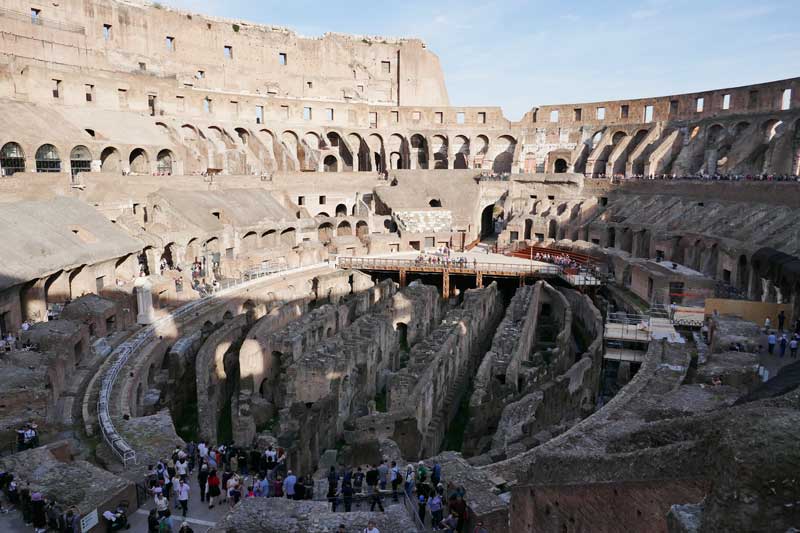
A tour of the Colosseum is an absolute must when visiting Rome. Today, walking through the ruins, it is hard to imagine that this structure was once an amphitheater holding around 45,000 spectators, seated—according to their social class—on tiers of marble, wood, or stone. The arena walls were clad in marble, and statues were set in niches on the second and third tiers. The uppermost tier supported 240 masts that hoisted a massive canvas awning (velarium) to shield the arena.
Construction of the Colosseum in ancient Rome began in 72 AD under Emperor Vespasian and was completed eight years later during the reign of his son, Titus. It was erected over the site of Emperor Nero's despised palace and was likely named after a colossal bronze statue (Colossus) of Nero that stood nearby.
The opening of the Colosseum was celebrated with one hundred continuous days of games, during which over five thousand animals were slaughtered.
It is chilling to imagine the setting, yet tens of thousands of spectators gathered to cheer these spectacles, where gladiators fought against their will, often to the death. The gladiators were prisoners condemned to combat, and it is estimated that hundreds of thousands perished in the arena battles.
Today, after centuries of pillaging, weathering, and damage under various circumstances, only about a quarter of the original outer wall stands at its full height.
In 2007, the Colosseum in Rome was voted one of the New Seven Wonders of the World.


Adjacent to the Colosseum lies the entrance to the Roman Forum. During the Roman Empire, the Forum was the civic center of the city—the focal point of public life where commerce, culture, politics, and religious events took place. Construction of the Forum spanned roughly 900 years, but for centuries it lay neglected and abandoned as a witness to the empire's fall. Conservation began at the end of the 18th century, yet archaeological excavations and discoveries continue to this day. The Forum complex holds numerous fascinating structures, each offering deeper insights into ancient history.
The thoroughfare crossing the Forum is the Via Sacra ("Sacred Way"), the main street of ancient Rome along which triumphal processions and religious parades were held.
The Arch of Titus is also located within the Forum. This triumphal arch commemorates the suppression of the Jewish rebellion during the Great Revolt, the conquest of Jerusalem, and the destruction of the Second Temple. The arch was erected by Emperor Domitian in honor of his brother Titus, who led the military campaign. On the inner relief of the arch, a procession portrays Roman soldiers carrying the sacred seven-branched Menorah from the Temple on their shoulders. Another arch is the Arch of Septimius Severus, Arco di Settimio Severo, built in 203 AD to commemorate the victories of Emperor Severus and his sons, Caracalla and Geta, over the Parthian Empire. Following Severus's death, his sons ruled together until Caracalla murdered his brother. Following the murder, all public likenesses of Geta were expunged, including his figure on the arch's reliefs and an equestrian statue above it. The Temple of Caesar is also located in the Forum, Tempio di Giulio Cesare, erected on the spot where Julius Caesar's cremation ceremony took place.
Throughout the Forum are additional temples, monumental arches, and ancient structures. Exploring the Forum and the Palatine Hill is a captivating journey back in time.


For visitors wishing to explore the underground chambers of the Colosseum combined with a guided walking tour of the Forum, this tour is warmly recommended: Colosseum Underground & Ancient Rome Guided Tour

Itinerary No. 3
Beyond its fascinating history, Rome is the undisputed capital of pizzas and pastas—in short, a culinary paradise. Befitting a city that honors great meals, fine wine, and artisanal gelato, taking a food tour is an exceptionally enjoyable experience.
A recommended company running these culinary outings is Gourmetaly, website: www.gourmetaly.com
The company organizes tours on various themes, such as wine tours or tiramisu tastings. However, for visitors who want to sample as much of the local cuisine as possible, the FOOD CRAWL ROME TOUR is recommended. The tour lasts about 3.5 hours, taking you through vibrant neighborhoods, lively markets, family-run bakeries, famed gourmet delis, and authentic restaurants tucked away from ordinary tourist paths—true gems cherished by locals.
Along the way, you will taste cheeses, cured meats, pastries, pasta, wine, gelato, and quintessential Roman classics like fried artichoke, the signature dish of the Jewish Ghetto. Engaging and delicious in equal measure!
The tour is paid and must be booked in advance via the company's website. Tours depart in intimate groups of up to 12 people. Each group is accompanied by an experienced guide ready to share insider recommendations on restaurants to try (and those to skip), where to track down the finest pizza, where to buy quality dried pasta to take home, and which specialties are best in each season.
This excursion offers travelers a fresh perspective on Rome, and in a city where gastronomy is central to local culture, a culinary tour is an absolute must!


After you've dined and indulged, you can continue the day by visiting the smallest country in the world: the Vatican, www.vatican.va. Although it is the smallest sovereign nation on the planet, home to only about 800 residents, the country has its own language (Latin), flag, currency, army, postal service, and even a radio station. It is one of the most visited destinations in Rome, largely due to its enormous religious significance for the Christian world in general, and Roman Catholics in particular.

The primary square in the Vatican is St. Peter's Square, Piazza San Pietro. Peter, considered the first Pope, was one of Jesus's twelve apostles. The square is grand and immense (accommodating up to 400,000 people!), centered by a 25-meter-high obelisk. The obelisk was brought from Egypt in 37 AD and erected in the square toward the end of the 16th century.


Directly bordering the square stands St. Peter's Basilica.

Admission to the basilica is free, but requires modest attire (and, inevitably, waiting in a substantial line). It is the largest church in the world, and from its central balcony, the Pope delivers major addresses. You can also climb to the dome of the basilica for sweeping vistas over the square and surrounding city. Accessing the dome requires a ticket, with options to climb via stairs or elevator.

The Vatican features additional extraordinary sites with paid entry. As with the Colosseum, purchasing tickets ahead of time through the official Vatican website is strongly advised. Booking in advance saves hours of waiting in line, so planning ahead is key. The admission ticket covers the Vatican Museums, the Apostolic Palace, and the Sistine Chapel.
The Papal Palace was established during the 12th century, but has since been renovated and enlarged numerous times. The palace houses the papal apartments and offices of the Holy See. The museum, by contrast, was established in the 16th century to showcase the popes' art collections to the public, fostering cultural, historical, and artistic appreciation. The museum complex spans two palaces linked by long galleries. The Vatican Museums hold remarkable collections including works by Renaissance masters such as Leonardo da Vinci, classical antiquities, ancient mosaics, Egyptian and Greek art, and more.
Within the Vatican Museums are the Raphael Rooms, Stanze di Raffaello—four rooms that served as the papal residence for Julius II and his successors. The chambers were decorated by Raphael, who personally painted several of the magnificent frescoes adorning the walls.
Also located within the museum complex is the Sistine Chapel, renowned as the Pope's personal chapel. The chapel is covered in stunning frescoes, notably Michelangelo's iconic "Creation of Adam", illustrating the book of Genesis. The centuries-old papal conclave also takes place within the chapel. Tradition dictates that within 20 days of a pope's passing, cardinals assemble for the secret ballot election of the next pontiff. The cardinals are cloistered in the chapel until a two-thirds majority is attained. A small chimney is set atop the chapel roof; upon successful election, the ballots are burned with special chemicals producing white smoke, signaling the announcement to the waiting world.