Trip to Plitvice Lakes National Park Plitvicka Jezera
General
Plitvice Lakes National Park is the number one attraction in Croatia. This nature reserve is considered one of the most beautiful and unique nature reserves in the entire world, and even those who have visited the national parks of the US and Canada will be captivated by its beauty. It is no wonder that the place was declared a WORLD HERITAGE SITE by UNESCO in 1979.
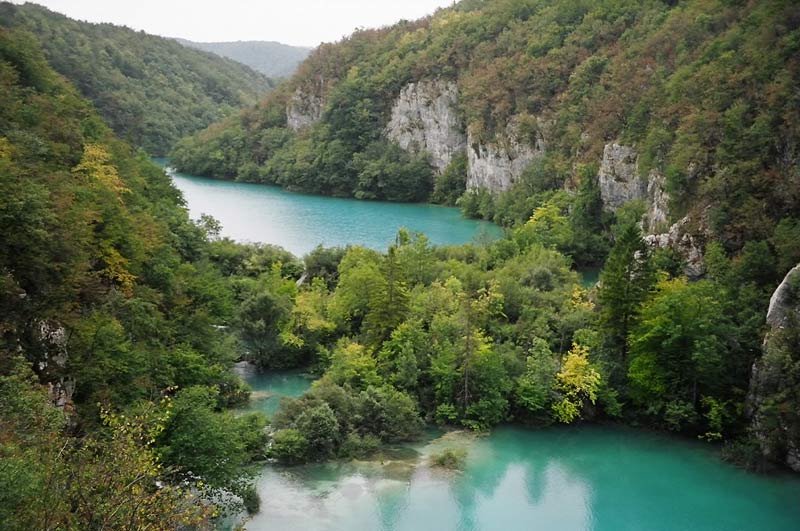
Many call the place "Paradise on Earth" thanks to its impressive beauty and the wonderful color of the lakes: a charming turquoise color. The amounts of water flowing in the dozens of waterfalls (over 90 waterfalls) evoke envy. It is hard to believe that Croatia's bloody war of independence started right here. In late March 1991, Serb rebels took over the park administration offices, and it was only in August 1995 that the Croatian army recaptured the park.
The park is located about a two-hour drive south of the capital city of Zagreb. You can book a guided tour to the park departing from the city of Zagreb:
♦ Booking a tour from Zagreb to Plitvice Lakes:
Hotels
The reserve is located, as mentioned, about a two-hour drive south of Zagreb, the capital of Croatia. There are a number of hotels there, but it is cheaper and nicer to stay in one of the many bed and breakfasts scattered around it in the surrounding villages and settlements. It is highly recommended to stay in the town of SLUNJ, which is located about 30 km north of the reserve (towards Zagreb). The town has a charming preserved quarter called "Rastoke Quarter" RASTOKE, which is also a nature reserve containing ancient houses submerged in rich vegetation (mostly B&Bs), among which are many streams and waterfalls. Wooden bridges connect the houses in the place. Even outside the quarter, there is a fairly large selection of B&Bs and restaurants. The town is a meeting point of rivers, and on hot summer days, it is recommended to refresh by swimming in the clear river water.
Recommended apartments in the park area:
Apartments designed to accommodate 4-6 people with an equipped kitchen and balcony. Free bicycles for guests staying at the property, which is located about 10 km north of the park entrance.
Quality two-bedroom apartments and a living room with an equipped kitchen. The house is surrounded by beautiful gardens with a seating area and barbecue. About 12 km north of Plitvice Park.
Air-conditioned and well-equipped apartments, including free internet 7 km from the park entrance.
Online booking of accommodation in Slunj on the successful Booking.com website.
In Slunj there are mainly guest rooms and B&Bs.
Those interested in apartments can stay between Slunj and Plitvice Park in one of the small towns.
Fortunately, the nature in the park and the delicate ecological balance were not harmed, but the tourism infrastructure was damaged and destroyed. After the end of the war, the hotels and tourist facilities were restored, and today visitors have at their disposal convenient walking trails, some on wooden bridges, hotels, restaurants, boats sailing across the largest lake, electric trains traveling between several stations in the sprawling park, and visitor centers.

The park covers an area of about 295,000 dunams, of which 220,000 dunams are forest and 2,170 dunams are lakes, and it has streams, waterfalls, and 16 lakes (12 upper lakes and 4 lower lakes). Each of the lakes is at a different level, and the water spills in waterfalls from lake to lake. The lake water is so clear that you can see the abundant vegetation at their bottom and the many fish swimming in them undisturbed. Since this is a nature reserve, fishing is prohibited in the park. In addition to this prohibition, there is a long list of prohibitions including: swimming is prohibited, hunting is prohibited, lighting fires is prohibited, picking flowers is prohibited, listening to the radio, and more. In fact, you are only allowed to walk along the reserve paths, observe its wonders, and photograph them. Believe me, that's enough.
The lakes were formed through slow karst processes over tens of thousands of years. The water flowing in the streams dissolved layers of limestone which sank in the passages between the lakes and coated the algae and vegetation at the bottom of the lakes. Thus, a calcareous material named travertine (known as tufa) was formed, which accumulated until it blocked the flow of water between the lakes and caused the formation of waterfalls. The process of forming new tufa barriers and breaking down old barriers by water currents continues to this day. This is a unique geological process for the existence of which a special combination of climate, vegetation, ecological environment, and precipitation is required. This balance is very special and delicate, which is why it is so carefully guarded.
The park has two entrances, near each of which is a large parking lot and a visitor center. Three walking trails depart from each of the entrances. One is intended for groups and the other two for independent travelers: one is designed for a 3-4 hour walk while the second for a 5-6 hour walk. Each of the routes is marked with a different color, making it easy to follow without losing your way.
The recommended and most successful route of all is the red route, which starts from entrance number 2. Although the trip takes about 5-6 hours, walking on it is easy and comfortable, and it is suitable for anyone in reasonable physical condition, including families with children (over age 5). You have to park the car in parking lot number 2, buy tickets at the visitor center adjacent to the parking lot, cross over a bridge above the main road, and enter the reserve. After a few minutes of walking, you reach the electric train station and ride it to its final station which reaches the highest lake among the park's lakes. The walking path passes by each of the upper lakes, close to many waterfalls, lush vegetation, and impressive mountain views reflected like a mirror in the clear lake water. Along the path are benches where you can rest from time to time. Since many are content with the shorter walking route, the number of people in the first part of the trail until it merges with other routes is relatively low, and you can marvel at the wonders of nature and listen to the chirping of the many birds without crowds of people walking around you. Most of the trail is a moderate and comfortable downhill walk.
The upper lakes:

After a leisurely walk between the 12 upper lakes, whose color is lighter than that of the lower ones and less impressive, but the water flow and waterfalls are more abundant, you reach the large lake named Kozjak Lake. From the lake pier, you board an open tour boat that sails for about 20 minutes the entire length of the lake to its other side in calm waters with a wonderful color and among pastoral landscapes. You arrive at a large lawn area, which serves as a stopping and resting point for large groups. The lawn is surrounded by stalls selling light meals (and not particularly exciting ones). For the independent traveler, it is better to find a quieter and more isolated place to rest or for a picnic and eat the main meal outside the park in one of the many authentic restaurants (whose hallmark is a pig rotating on a grill outside the restaurant) scattered along the main road between the park and Slunj.
The trail continues along the lower lakes and this in my opinion is the most picturesque and impressive part of the entire park. Nature's color palette in this area is simply amazing!
Walking trail between the lower lakes:

You can deviate slightly from the main path to short side paths and see the highest waterfall in the park or visit a large cave, but it is worth saving your energy for the end of the trail. This is the hardest part of the trail because it involves a fairly serious climb. Whoever gets tired can rest on one of the many benches scattered along the trail and look out at the wonderful view of the lakes. At the end of the climb, you will be rewarded with the most beautiful view: the sight of the lakes from a great height. Although you have witnessed the lakes for several hours, you still won't be able to stop marveling at their color. At the end of the trail, take the electric train that will take you to entrance number 2 of the park, near the parking lot where your car is waiting for you.
It is recommended to purchase a guidebook in English about the park at the visitor center which includes, in addition to dozens of pictures, a lot of information about the geology, history, climate, flora, and fauna in the reserve and a detailed description of all the lakes in the park, including their name, depth, and size. It is also worth buying a large, detailed map of the park because the general map included in the park entrance ticket is rather mediocre.
Rastoke Quarter

Plitvice Lakes National Park is open every day of the year (except on days when the area is covered in snow).
In the hot and tourist-crowded summer months, it is advisable to arrive at the park as early as possible in order to avoid walking in heavy heat and heavy visitor congestion as well...
The park entrance fee varies depending on the tourist seasons (the expensive price is in the months of July - August).