Berlin Travel Guide
In recent years, Berlin has become one of the most sought-after destinations for Israeli tourists. It's not just the inexpensive Milky pudding that attracts thousands of Israelis, but also the history, the political upheavals the city has undergone just in recent decades, the vibrant nightlife, the multicultural diversity, and let's be honest—the shopping experience and relatively low prices compared to its European neighbors.
Berlin attracts not only Israeli tourists, but also many immigrants. Germany's capital is one of the most popular immigration destinations in the world, and not just for Israelis. High salaries and relatively low real estate prices attract hundreds of thousands of educated, skilled Western immigrants. In fact, more than one million people—about 70% of them from European countries, and about a third with an academic background—immigrated to Germany in the past year.
♦ Recommended Hotels in Berlin
1. Adina Apartment Hotel Berlin Hackescher Markt
A recommended apartment hotel (studios up to 2-bedroom apartments) in a central location - Hackescher Markt, right next to the central Alexanderplatz square.
2. Hotel Indigo Berlin-Alexanderplatz
An excellent 4-star hotel, within walking distance of the central square Alexanderplatz.
3. Holiday Inn Berlin-Alexanderplatz
A 4-star hotel from the Holiday Inn chain in an excellent location.
4. Adina Apartment Hotel Berlin Hauptbahnhof
A recommended apartment hotel in a good location in the Mitte district, within walking distance of the new Central Station and close to the bustling Friedrichstraße.
Recommended Guided Tours in Berlin
Suggested Itinerary in Berlin
Berlin is suitable for a visit in any season. Naturally, in summer the city is livelier and more vibrant, but even during the winter season the attractions remain open and lines are even shorter. On days that are not very rainy or snowy, it is very pleasant to wander around the city and sample everything it has to offer.
Berlin has a bit of everything – it is suitable for history buffs wanting to see with their own eyes where some of the greatest horrors of the 20th century took place, but it is also great for nightlife lovers wanting to enjoy wild parties. Berlin suits shopping enthusiasts looking to expand their wardrobe, and it also caters to culinary lovers who want to taste local cuisine, wine, and beer. Berlin suits fans of museums and galleries, as well as families with children looking for attractions for every age. Berlin has something for everyone, making it ideal for a family vacation or a couples' getaway.
Getting around Berlin is easy and convenient, primarily thanks to its extensive and advanced public transportation network. Bus lines, the U-Bahn (underground subway), the S-Bahn (overground train), and tram lines are all at your disposal. The numerous options make getting from place to place exceptionally fast. A single ticket covers all modes of transportation. It is particularly worthwhile to purchase a daily, weekly, or monthly travel pass (depending on the length of your stay). Another option is to purchase a Welcome Card. For a small addition to the daily transit price, you receive a pass combining all public transit options along with discounted admission (usually a 25% discount) to most of the city's museums and attractions.
♦Car rental from the reliable and convenient Booking website: Booking.com
Main City Attractions
The Central Square, Alexanderplatz
Any trip to Berlin starts at the central square, Alexanderplatz. Alexanderplatz is the beating heart of Berlin. It is an urban and historical center, named after the Russian Tsar Alexander I. Over the years, the square served as a strategic point and a landmark for multiculturalism and political change. Today, the square functions as a major shopping hub and a central transit crossroads in the city. The square boasts an interesting history: in November 1989, about one million people gathered in the square to protest against the regime—a demonstration that took place shortly before the fall of the Berlin Wall and was, in fact, the largest protest ever held at Alexanderplatz.
The Television Tower, Fernsehturm
At the square—and virtually from every vantage point in the city—you cannot miss the Television Tower, Fernsehturm. The tower rises to a height of over 360 meters, making it undeniably the tallest structure in Berlin. The idea behind the tower's construction was conceived in 1958 as part of the East German government's efforts to build an iconic office tower. Two German architects proposed the structure's design and dubbed it the "Tower of Signals." For a panoramic view of the city, you can take an elevator to the top of the tower, where on a clear day you can see up to about 40 kilometers away. Additionally, there is a revolving restaurant where you can dine comfortably while watching the cityscape rotate before you. It is recommended to book tickets in advance to avoid long wait times for the ascent. www.tv-turm.de

Berlin Cathedral, Berliner Dom
Another iconic structure that is hard to miss is the Berlin Cathedral, Berliner Dom. A massive (!) and magnificent cathedral that once served the royal court and now functions as a place of worship, a museum, and a concert hall. It is highly recommended to climb up to the viewing gallery to see the impressive glass mosaic in the dome up close and enjoy a breathtaking view of the city. Keep in mind that reaching the observation deck requires climbing 267 steps on foot. Another major attraction is the Sauer Organ, boasting no fewer than 7,296 pipes.

DDR Museum
Adjacent to the Berliner Dom is a small, private, and fascinating museum depicting the lives of East German residents during the years of communist rule. The museum, called DDR, documents life in East Germany and provides an authentic window into everyday life: from the family living room, through sports competitions, children's lives, and youth movements, all the way to the Stasi interrogation room.
Unter den Linden Boulevard
The city's main boulevard, Unter den Linden, is the grand avenue of historic Berlin. Although the avenue started as a romantic walkway, Berlin's dark history is deeply interwoven into it. During the Third Reich era, numerous marches and rallies of Reich soldiers took place along the boulevard. To avoid obstruction, soldiers cut down the many trees that shaded the avenue. During the war, most buildings were damaged and the boulevard lost its grandeur. Today, Unter den Linden is considered one of the most beautiful avenues in Europe. In Berlin itself, the boulevard serves as a central axis, lined on both sides by the city's most important landmarks.
The boulevard stretches from the Brandenburg Gate to Marx-Engels-Platz (currently named Lustgarten) and houses most foreign embassies, museums, shopping centers, restaurants, cafes, and a vibrant nightlife scene.
Brandenburg Gate
Today, it represents one of Berlin's most important symbols. The gate is the only remaining survivor of several city gates that once served as entry points to the city. Designed with Greek inspiration, the top of the gate is adorned with the Quadriga—a chariot drawn by four horses driven by the goddess of victory (Nike) holding an olive branch. With the rise of Nazi rule, the gate served as a symbol of their power and is one of only two structures that survived World War II. Following the war, the gate was restored, but in August 1961, with the construction of the Berlin Wall, the area became an enclosed zone. The gate was closed to traffic and all passage between its eastern and western sides was prohibited. In 1989 the Berlin Wall fell, and on December 22—about a month and a half after the wall was breached—the gate was reopened. On December 21, 2000, at a cost of nearly 3 million dollars, the gate was fully renovated and restored. The gate, one of Germany's most significant icons, is embossed on German 10, 20, and 50-cent Euro coins.

Reichstag Building
Adjacent to the historic gate lies the most important political center in the city: the Reichstag Building. With the establishment of the German Empire, which united the German principalities, an urgent need arose to construct a fitting building to house all representatives of those principalities under one roof. Bismarck designated Berlin as the seat of parliament and built the Reichstag in central Berlin, close to the Brandenburg Gate. In February 1933, the Reichstag was set on fire, and the Nazis blamed the communists for the arson. The Reichstag continued to exist until 1939, but without any real political significance, serving merely as a rubber stamp to legitimize Hitler's dictatorial rule. At the end of WWII, the building became a symbol of victory over Nazi Germany when the famous photograph of a Soviet soldier raising the USSR flag over the ruins of its roof was published. About a year after German reunification, in 1991, it was decided to return the title of German capital from Bonn to Berlin, and it was only natural that the Reichstag building would serve as the parliament house of the united nation.

You can arrange a visit and guided tour of the Reichstag, during which you will visit the library, the parliamentary plenary chamber, and historical rooms. The tour lasts about an hour and a half. Those short on time can visit just the Reichstag Dome. The dome is transparent and features spiraling public walkways from which visitors can look out over the city of Berlin on one side and down into the parliamentary plenary chamber on the other. The concept of the transparent dome is intended to symbolize the openness and transparency of post-reunification German democracy. The guided tour is free of charge, but advance reservation is required. At the end of the tour, you can visit the Reichstag Dome without having to book a separate ticket. Note that lines for dome tickets can be very long, and taking the guided tour helps you bypass them...

Adjacent to the Reichstag building, you will find the Bundeskanzleramt – the German Chancellery, a glittering modern structure in the shape of the letter H. The building consists of two long office wings with a white cube nestled between them. This is the office of the Federal Chancellor.
Checkpoint Charlie
Despite the modern architecture, one cannot visit Berlin without reflecting on the reality that prevailed in the city not so long ago, until the late 1980s. A reminder of that grim era can be found today at Checkpoint Charlie—the border crossing and inspection point between East and West during the Cold War. Right next to the checkpoint, you will find remnants of the Berlin Wall. The concrete wall before you was not the only barrier facing East European residents—guard towers were stationed along the fence, alongside automatic firing devices, bunkers, and hundreds of anti-vehicle ditches. Very few sections of the wall remain standing today, serving as memorial sites. Even the standing segments look different now from how they appeared during the days of the divided city.
Since 1989, with the fall of the wall, the area has become one of the most popular tourist sites in Berlin. The original guardhouses were moved to a Berlin museum in 1990, and all that remains at the crossing point is a symbolic wooden shack with an actor or two dressed in American military uniforms taking souvenir photos with tourists for a fee.

East Side Gallery
Another testament to the Berlin Wall can be found at the East Side Gallery. This is a 1.3-kilometer section of the wall located near the East Train Station (Ostbahnhof), right on the banks of the Spree River. The eastern side of the wall is covered with murals by international artists, mostly themed around peace and international brotherhood. In fact, it is the largest open-air graffiti gallery in the world.

Berlin's history is almost unfathomable. At Potsdamer Platz, this sensation is felt twofold. It is one of the liveliest and busiest squares in Europe. In the 1920s and 30s, the square was a major European intersection, and after being completely destroyed in WWII, it was reconstructed and reopened in 1998. Today, it is a massive, bustling commercial center featuring a shopping mall, cafes, cinemas, and bars. At first glance, it is very hard to believe that this square lay deserted and completely ruined after World War II. However, indeed no building survived here. After the war, the Wall ran straight through the middle of the square, and a wide death strip spanned its center, allowing East German soldiers to shoot at border crossers.
Kaiser Wilhelm Memorial Church
A short ride from the square brings you to the Kaiser Wilhelm Memorial Church (Kaiser-Wilhelm-Gedächtniskirche) – an impressive lone remnant of a grand memorial church built for Emperor Wilhelm I. The church was destroyed by Allied bombing during WWII, and all that remains today is the charred and scarred spire. In the late 1950s, restoration and preservation work was carried out on the tower, which was in danger of collapsing, and it has since become one of the city's iconic landmarks.
Olympic Stadium
You will find more than just churches and squares in Berlin: a 30-minute ride from Alexanderplatz brings you to the Olympic Stadium (Olympiastadion). Here too lies a fascinating piece of history. The stadium's construction was completed in 1936, when Germany hosted the Olympic Games. From the VIP box watched Adolf Hitler, who was reluctantly forced to witness African-American athlete Jesse Owens win gold medals, becoming one of the symbols of the Olympics and a triumph over Nazi propaganda.
From then until today, the stadium has hosted several major sporting events, such as the 2006 World Cup Final (for which it underwent extensive renovation) and the 2015 Champions League Final. Since the early 1960s, the stadium has served as the home ground for Hertha Berlin, drawing an average crowd of over 53,000 spectators per match in recent years.
A tour of the stadium gives you the opportunity to explore the Olympic complex and walk around the stadium inside and out.
For football fans, attending a Hertha Berlin match to experience the fantastic football atmosphere is highly recommended, at prices that are quite reasonable compared to exorbitant rates in other European leagues. https://www.olympiastadion-berlin.de/en.html

Jewish History
In Berlin, you won't find a single "Holocaust Museum." There is no single defined venue that covers the horrors of World War II; rather, history is etched into the very fabric of the entire city. In squares, across streets, and even embedded in the sidewalks, you will find numerous references to what took place, preserved memories, or memorials. History is spread across the city rather than confined to an enclosed space. Nonetheless, there are several key recommended spots that tell the story of Jewish life in the city.
Bebelplatz
The square is flanked by three large, impressive structures – the State Opera building, the university, and St. Hedwig's Cathedral. Amidst these sprawling buildings, it is easy to overlook the memorial – because unlike other monuments, it does not rise above ground level, but rather lies beneath your feet.
This square was the site of the first Nazi book burning in May 1933, where books written by Karl Marx, Thomas Mann, and others were torched. At the center of the memorial, the artist chose to commemorate the void, the absence. Through a glass window set into the cobblestones, you can look down into an empty library—large, bare shelves that memorialize the burned books and the destroyed culture. Beside the monument is the chilling quote by Heinrich Heine: "That was only a prelude; where they burn books, they will in the end burn human beings." Heine's own books, incidentally, were also set on fire in 1933.
Holocaust Memorial (Holocaust-Mahnmal)
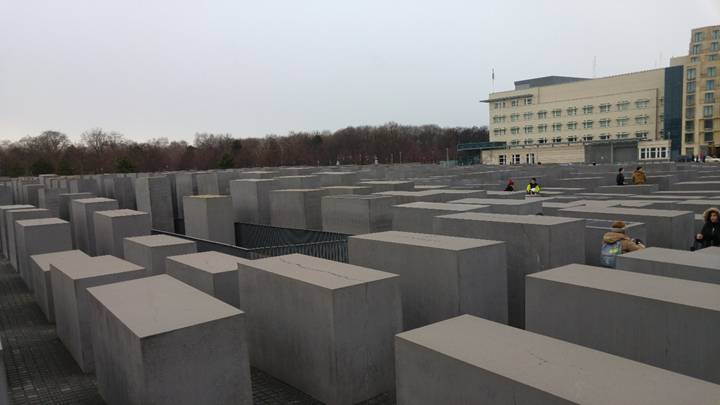
The Memorial to the Murdered Jews of Europe. Located in the very heart of Berlin, close to the Brandenburg Gate, stands the memorial commemorating Europe's Jewish victims of the Holocaust. Inaugurated in 2005, it comprises 2,711 concrete slabs (stelae) with a fixed footprint of two meters by one meter, strongly resembling rows of sarcophagi, differing only in height ranging from a few centimeters to five meters. The monument's designer, Peter Eisenman, sought to evoke an unsettling feeling of disorientation and alienation among visitors. At the edge of the field of stelae lies the entrance to the underground Information Centre, which chronicles the suffering and persecution endured by European Jews under Nazi rule.
The Jewish Museum
The Jewish Museum was originally founded and operated starting in 1933, showcasing Jewish settlement in Berlin from its earliest days. In 1938, under the Nuremberg Laws, the Nazi regime ordered the museum closed. In 1978, the museum's activities were revived, and in 2001 it moved to its current iconic premises. The zinc-clad building features windows arranged in a striking, seemingly random pattern. The museum structure itself is unique and serves as an exhibit in its own right. Shaped like a zigzag, the building's architect mapped out significant Jewish locations in Berlin along with the former homes of Jews deported to extermination camps during the Holocaust, drawing connecting lines that formed the structural basis for the design.
The museum is composed of three underground intersecting axes, none of which is primary, designed to evoke a sense of disorientation and fragmentation. One axis leads to the Axis of Death and the Holocaust Tower, where personal belongings of Jewish families who perished in the Holocaust are displayed. This axis culminates in a stark tower without windows, save for a single small slit through which light, air, and distant street sounds filter in. The tower captures the isolation of Jews forced into hiding during the Holocaust.
The second axis is the Axis of Exile—a long corridor leading outside to the Garden of Exile, where 49 concrete columns stand on a sloped foundation, reminiscent of the Holocaust Memorial. The third axis is the Axis of Continuity—intersecting the previous two and symbolizing the enduring continuity of German Jewry despite the Holocaust and forced flight. A prominent staircase rises all the way to the top of the building, symbolizing the historical rupture of German Jewish life.
Within the museum spaces are designated memory voids in tribute to Holocaust victims. In one of them is Menashe Kadishman's installation "Shalekhet" (Fallen Leaves), featuring over 10,000 screaming metal faces cut from heavy iron plates. The artwork is designed to create clashing, jarring sounds as visitors walk over the faces, though the visceral emotional impact of the piece often makes visitors hesitate to step on them.

Visiting the Sachsenhausen Concentration Camp
It is chilling to realize that just a 30-minute drive from central Berlin and the bustling Alexanderplatz stood and operated a concentration camp where countless Jews—as well as opponents of the Nazi regime such as pro-Soviets, homosexuals, and others—were imprisoned, humiliated, starved, cremated, and murdered. The concentration camp is located right in the middle of a residential neighborhood. The realization that nearby residents heard, saw, and smelled the atrocities of the camp will linger with you for hours and days after your visit.
Sachsenhausen was the primary concentration camp for the Berlin area during the Nazi regime. It was established in the Sachsenhausen district of Oranienburg, a northern suburb of Berlin, as one of three early concentration camps built in Germany for opponents of the regime (alongside Dachau and Buchenwald). The camp operated between 1936 and 1945, with estimates indicating that nearly 100,000 people lost their lives here out of approximately 200,000 prisoners sent to the camp. After the war, Sachsenhausen served for several years as a Soviet special camp. Do not miss a visit here. Walking with heads held high from the train station to the camp—the exact same path walked by hundreds of thousands of Jewish prisoners—represents the true victory of the Jewish people.

Shopping Centers
The main shopping boulevard, Kurfürstendamm (Ku'damm), has everything a shopping lover needs: lined with flagship stores of leading retail chains alongside upscale luxury designer boutiques. You'll find branches of H&M, C&A, Benetton, Nike, as well as the world-famous department store KaDeWe (Kaufhaus des Westens).
Shoppers have plenty more to explore beyond Ku'damm. The central Alexanderplatz square is a true shopper's paradise, offering major retail stores like H&M, C&A, and a large Primark branch that draws crowds of tourists. Also on the square is the Alexa Shopping Centre—a spacious, 3-story mall offering a wide variety of shops, restaurants, and boutiques. It's well worth visiting the "Mini Berlin" exhibit on the mall's top floor, which provides a fascinating miniature perspective of the city: Loxx Miniature Worlds Berlin (admission fee applies). www.loxx-berlin.de

The Potsdamer Platz area is another fantastic shopping hub. Right by the square stands Mall of Berlin—undoubtedly one of the city's top shopping destinations, if not the best! It is the largest mall in Berlin, opened in 2014, housing 270 fashion, footwear, homeware, and food stores, along with a massive food court.
Also at Potsdamer Platz is the Potsdamer Platz Arkaden shopping arcade, featuring a diverse selection of shops and eateries. A short ride away, near the Kaiser Wilhelm Memorial Church, you'll find the Europa-Center, widely regarded as one of Berlin's top three shopping complexes, complete with numerous retail shops, cafes, pubs, and restaurants.
Tours in Berlin
Among the many Israelis living in Berlin, quite a few offer guided tours. It is a wonderful opportunity to learn about the history, ancient architecture, culture, and art from an experienced guide.
Berlin Tours - Nadav's Tours
A highly recommended tour company is "Nadav's Tours," offering tours on various themes such as Jewish Berlin, Alternative Berlin, and street market tours. First-time visitors should consider the "Best of Berlin" tour—a comprehensive 5-hour excursion covering must-see sites like the Holocaust Memorial, Checkpoint Charlie, Potsdamer Platz, Berliner Dom, Hitler's Bunker, and more.
Food Tours - German Food Tour
After walking, sightseeing, exploring, and shopping—it's time to eat! A unique way to get to know the city is through your stomach... German Food Tour, true to its name, offers culinary tours across the city that introduce you directly to authentic local flavors. The culinary tour is an absolute highlight: you will visit four different restaurants, each serving specialty dishes from a different region of Germany. At each stop, you will taste authentic food paired with locally brewed beer or regional wine. All stops are small, family-owned restaurants rather than commercial chain eateries. Along the way, your guide will share stories about the city's history, the evolution of its culinary scene, the restaurant boom after the fall of the Berlin Wall, and local culture. It is a fantastic way to experience Berlin's history from a different perspective while savoring the best of German gastronomy. Note that vegetarian options can be arranged with the guide in advance, but the tour does not feature kosher-certified restaurants.


The World Beneath Berlin - Berlin Underworlds
And finally—while above-ground Berlin is well-known, have you ever wondered what the city looks like beneath the surface? The Berlin Wall, which divided the city in two, spurred a fascinating world of escapes and underground crossings from East to West. During the Cold War, more than 70 escape and supply tunnels were dug dozens of meters beneath the wall. These subterranean escape routes passed under factories and secret munitions depots right under the nose of the Stasi secret police. A captivating tour takes you directly into these historic escape routes. Advance bookings are not available, so it is best to arrive at the ticket office early in the morning before tickets sell out and lines grow long. Don't miss this unique opportunity to hear daring escape stories and discover the clandestine tunnels built by people whose only wish was to reunite with their loved ones in the West.
In conclusion, Berlin is an ideal destination for families and couples alike. Spending around 5 days in Germany's capital offers the perfect balance of fascinating history, exceptional shopping, vibrant nightlife, and a thriving culinary scene.
In recent years, an increasing number of low-cost flights have been operating to Berlin, offering highly attractive fares.
Written by: O. E. Bar