Trip to Sapa and Surrounding Villages
The city of Sapa is located about 320 km northwest of Hanoi. The city is situated in a mountainous region at an altitude of about 1500 meters above sea level. The main attraction of Sapa is the many villages surrounding it, which cultivate their fields on breathtaking terraces across the hills and mountains. The local residents belong to various tribes with different languages and colorful attire unique to each tribe. Hiking among these villages, their residents, and the rice terraces is a special experience.
♦ Book on Viator: Private transport between Hanoi and Sapa: Private Transfer from Hanoi to Sapa or from Sapa to Hanoi

♦ Recommended tours in Sapa (Book on Viator):
In 2016, a new and recommended attraction was added to Sapa. The cable car to Mount Fansipan, the highest mountain in Vietnam at 3,143 meters high. The 6.3 km long cable car passes over rice fields with their spectacular terraces and over impressive mountain views on its way to the summit from which an amazing view is revealed.

Getting There
In the past, people used to travel from Hanoi to Sapa by overnight train on a trip that took about 8 hours plus another hour from the train station in the neighboring city. Today, it is preferable to travel from Hanoi to Sapa by car, via private transfer or otherwise, taking about 5 hours on the highway paved several years ago. Most of the way to Sapa is a highway; only near Hanoi and before Sapa is the drive slow. There is nothing special to stop and see along the way. The highway ends near the city of Lao Chai, and from there up to Sapa, you drive up a winding and scenic mountain road for about an hour.
Accommodation
It is recommended to stay in Sapa for 2-3 nights, which will allow at least two full days of touring in the region.
Recommended Hotels:
Pao's Sapa Leisure Hotel- A 5-star hotel at an attractive price on the edge of the city. Every room offers a breathtaking view of the terraces. The hotel features an excellent breakfast in a restaurant with a wonderful view, additional restaurants, a bar, an indoor pool, a gym, a spa, and even a children's playroom. The hotel offers shuttles to the city center. Free internet.
Silk Path Grand Resort & Spa Sapa- A high-quality 5-star hotel with an indoor pool, an infinity pool with a view, a gym, a spa, a restaurant, and a bar. Indoor playroom for children, playground, free bicycles, billiards, free internet.
Hotel de la Coupole – Mgallery- The most expensive and newest 5-star hotel in Sapa, belonging to the high-quality Sofitel chain. Located in the city center, adjacent to the Sun Plaza shopping center. The hotel features a fine restaurant, bar, indoor pool including a children's pool, gym, spa, kids' club, and game room.
Sapa Horizon Hotel- A successful 4-star hotel in a central location in the city. The hotel features a restaurant, bicycle rental, and bicycle tours for an extra fee, a spa (for an extra fee), free internet.
The Weather
Since Sapa is located in the north of the country and high up in the mountains, the weather is cool compared to other destinations in northern Vietnam. In winter, it is really cold and rarely even snows. The coldest month is January, when the average temperature ranges from 6 degrees at night to 12 during the day, but of course, there are also colder days. Even in the hottest summer months, July and August, the temperature is comfortable and ranges between 18-24 degrees Celsius. In fact, the temperature from May to September is fairly similar and very comfortable. Rain can fall in all months of the year, but the wettest season is in summer, whereas in the winter months, very little rain falls. The rainy season officially begins in late April, but the rainiest months are July and August, with rainfall of almost 500 mm per month.
Touring Sapa City
Sapa is located, as mentioned, among mountains at an elevation of about 1,500 meters above sea level, surrounded by mountains and agricultural villages.
Here is a view of the city from the cable car leading from it to the highest mountain in Vietnam, Mount Fansipan:
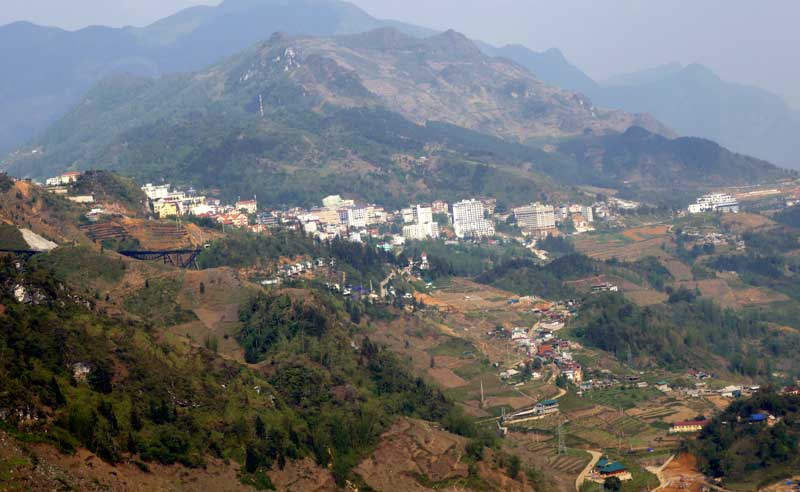
Sapa is one of the most popular and visited cities in northern Vietnam, growing and developing at a rapid pace. As of April 2019, the streets in central Sapa are undergoing massive renovation of sewage channels, repairing sidewalks, and paving roads, which causes traffic jams and dust in the city.
It is recommended to start your trip in Sapa with a local guide who will explain the sites and the local people. In central Sapa, there is a large main square named Love Market Sapa, where a "Love Market" is held on Saturday evenings, where locals look for partners. The famous church of Sapa is located in the square (many of the villagers in the surrounding area are Christians).
Love Market Sapa:

Nearby is a modern shopping center named Sun Plaza from which the train departs toward the cable car to Mount Fansipan (details below).

Close by is Sapa Lake, illuminated at night with colorful changing lanterns, surrounded by a lovely promenade.

In the city center, there are many peddlers from the village tribes in their characteristic attire trying to sell their goods to the many tourists, using their small children aged 3-4 dressed in traditional clothes to offer various souvenirs to tourists. The main streets are full of shops (it is recommended to bargain!), restaurants, and bars. It is also worth visiting the small, charming night market in the city, where they mainly sell grilled food over charcoal, various types of meat including chicken, beef, pork, frogs, and more. Also available are roasted chestnuts, almonds, all kinds of dried fruits, and spices. The place also has many tables for diners.

Touring the Fields and Villages Around Sapa:
As mentioned, the main attraction in Sapa and its most famous pictures are the rice terraces surrounding it on all sides. In Sapa, due to its altitude and relatively cool weather, rice is planted only once a year (unlike most other places in northern Vietnam, where it is planted twice a year, and southern Vietnam: 3 times).

In April, planting begins gradually. From May, the first growth of rice can be seen, and the terraces turn green in the following months. When the rice ripens, the color of the terraces turns yellow (late August, early September). During September, the rice is harvested. It is important to know that between October and March, the terraces are without rice plants, so they are brown rather than yellow or green like in the famous, lovely photos.

Many companies offer tour packages to Sapa during all months of the year. Among the offered tours are trips starting and ending in Hanoi. That is, pickup from the hotel in Hanoi, transportation to Sapa by car, train, or bus, guided walking tours in the villages around Sapa, a night or two of accommodation in Sapa or at a private home in one of the villages (Homestay), and return to the hotel in Hanoi.
You should equip yourself with clothing appropriate for the season, good walking shoes (or boots when muddy—mainly from May to September), a raincoat, a wide-brimmed hat, sunscreen, and insect repellent. Whatever you are missing can be bought in Sapa town and also in some of the more touristy villages.
The town of Sapa is located, as mentioned, in a mountainous environment surrounded by villages. From the city, hiking trips set out into the villages and rice fields at its foot. It is best to take a tour that includes transportation to the starting point and pickup from the end of the route back to your hotel in Sapa; otherwise, you will have to walk all the way back uphill. It is highly recommended to hire a local female guide (most guides there are women) born and residing in one of the villages, a member of one of the tribes, who can share authentic, personal information about the village lifestyle and take you along less-traveled paths and tracks between rice terraces and other crops (like marijuana and peanuts).
Trip Between the Villages Lao Chai and Ta Van
On a 4 km walking tour between the villages of Lao Chai, Ta Van, and the rice fields, you pass through fields with terraces and, of course, through village alleys between local homes, shops, and many animals raised by locals, such as pigs, chickens, buffalo, and plenty of dogs.

Women preparing the rice terraces for planting:

At the beginning of the trip between the villages, many female peddlers try to sell their goods to tourists. They stay close to hikers for hundreds of meters until some manage to sell something to tourists.

The residents in the villages belong to various ethnic minorities, mostly from the Hmong tribe, each characterized by different clothing—some in black and some colorful and vibrant. The dominant majority are the Black Hmong, named so because they wear characteristic black clothing except for colorful decorations. Women usually carry a large straw basket on their back in which they carry groceries, equipment, and more.

Each tribe also has its own language besides Vietnamese. Visiting a local family's house reveals wooden homes with tin or asbestos roofs without windows, very dark with minimal furniture and very basic amenities.

On the tour, you learn how dye is made for coloring fabrics black and blue from the marijuana plant, and you see local women weaving fabrics on a loom.

Dye container for fabric dyeing:

What is surprising is that despite the simple lifestyle of the locals, almost everyone has a mobile phone (most prefer iPhones... despite the high price) and cellular reception everywhere is excellent.
Trip Between the Villages Cat Cat and Xin Chai
To tour between the villages, you need to buy a ticket. You walk down a narrow path between many souvenir shops. Most of the shops belong to non-local Vietnamese. Cat Cat village is very touristy, and many tourists walk around, including many organized groups arriving in large buses.

This is the place where you hear Hebrew the most...
A small stream with several waterfalls flows through the center of the village.

A hydroelectric power station was established here during French rule in Vietnam. Today, inside the station building, they have placed a stage and present a music and dance show performed by local dancers in traditional costumes. The village center is very well-maintained and ornate, not at all like the authentic villages around it.

To the neighboring village of Xin Chai, you must go uphill on foot or take a 3 km drive. In this village, there are almost no tourists, and it is more authentic.

The wooden houses have almost no windows and are dark to maintain the temperature inside.
A rural house, cooking smoke comes out of the doorway:

Surrounding them are rice fields and animals—pigs, dogs, ducks, and chickens, all roaming freely.

A narrow concrete path runs along the village, and local residents, adults and children, pass along it in their characteristic attire. Sometimes, scooters driven by adults and even very young teenagers pass by. In this village, no peddlers or vendor shops were seen at all.


Day Hike Between Villages Suoi Ho —> Matra —> Ta Phin and Rice Fields
The first village visited, Suoi Ho, is a 5-minute drive north of Sapa.
The trip between the villages from Suoi Ho to Ta Phin is on foot. You set off from a point near Sapa toward the nearby village of Suoi Ho. The walk is pleasant, with moderate ascents and descents along the way, passing by locals' homes and fields. In Suoi Ho, they grow a lot of wild artichoke plants, which have very small fruit that locals do not eat, using the leaves for tea and oil instead. But, of course, most of the time you walk between rice terraces. In this village too, the residents belong to the Hmong tribe.

The houses in Suoi Ho village are spread apart, with agricultural fields in between where you see locals (mainly women...) working in the fields, in construction, or leading buffalo to pasture. Some even do so while carrying a baby on their back!


From there, you continue on foot toward the village of Ma Tra. You walk along narrow paved concrete paths suitable only for motorcycles.
In this village too, the houses are scattered across the area, with rice terraces between them and plenty of animals roaming freely everywhere.
The third village, Ta Phin, is located 9 km north of Sapa and spreads over a large area; the houses are far apart, but it has a commercial center with shops and a school, making the street resemble a small town street. The residents belong to the Black Hmong and Red Dzao minorities, characterized by different traditional attire—one wearing black clothes and the other red hats.

Unlike previous villages, besides rice fields, Ta Phin has a wide variety of crops, some in greenhouses: orchids, chrysanthemums, strawberries, tomatoes, beans, and more.
Various crops in Ta Phin village (rice terraces are visible only on the left side of the image):

In Ta Phin, you can also walk right inside the fields, accompanied by a guide of course, taking care not to step on the seedlings. You can reach a hill in the middle of the fields, which offers a breathtaking panoramic view of most of the village, with all the fields and terraces spread out below the viewpoint.

Short Video About Trips Between Villages Around Sapa:
Cable Car Trip to the Summit of Mount Fansipan
In Sapa, there is an impressive new SunWorld cable car, about 6.3 km long, climbing from Sapa to the highest mountain in Vietnam, Fansipan. The cable car takes you from the starting point in Sapa up to an altitude of about 3,000 meters, from where you continue to a panoramic viewpoint at an altitude of 3,143 meters.

At the summit, there are numerous pagodas and huge, impressive Buddha statues that present a dramatic contrast to the landscape.


The cable car began operating in 2016. In my opinion, this is a must-see attraction for anyone visiting Sapa. This cable car holds two Guinness World Records for a 3-rope cable car system: it is the longest in the world and has the greatest elevation gain (1,410 meters).
The cable car station in Sapa can be reached by car or taxi, but it is recommended and preferable, both in terms of price and scenery, to take a new train carriage inaugurated in 2018, which runs from central Sapa to the cable car station. The carriage travels for about ten minutes through an impressive landscape of villages, rice fields, and mountains.

From the cable car cabin, you get a beautiful view of Sapa town, the surrounding mountains, and villages.

Initially, the cable car cabin travels through magnificent scenery high above the Muong Hoa Valley, where picturesque villages with terraced rice fields are located, where tourists typically hike.

And afterwards over forested mountains with impressive views far into the distance.

At the end of the cable car ride, there are about 600 steep steps to climb to reach the mountain peak, but for those who wish, there is a funicular—an inclined railway car available for an extra fee that takes you almost all the way to the top.

It is best to ride up on the funicular and walk down to get a better view of the scenery, all the statues, and the impressive temples, but keep in mind that the steps going down are very steep.

The entire excursion, including the train rides round-trip to central Sapa, takes about 3-4 hours.
Short Video About the Cable Car Trip to Mount Fansipan: