Trip to Yellowstone National Park
♦ Routes (free): Detailed travel itineraries in USA
Northwest Wyoming on the border with Montana and Idaho
Itineraries: Detailed itineraries in the United States (free)
General
Yellowstone was the first park in the USA to be declared a national park, back in 1872. It is the largest and most famous of all national parks. Its size is 9,027 square kilometers, and to see its particularly interesting and impressive areas, it is recommended to dedicate at least three days to the visit. The park is located in an area that had intense volcanic activity, which led to the formation of a central elevated plateau surrounded by low hills. The height of the central plateau is 2,400 meters. The highest point in the park, at an altitude of 3,600 meters, is located on the eastern border of the park at Eagle’s Peak. Most of the roads in the park are at an altitude of 2,200-2,400 meters.
The phenomena that led to Yellowstone's declaration as a national park in order to preserve it are mainly geological: the geothermal phenomenon - more geysers and hot springs are concentrated in the park than in the entire world! In addition, the park features a colorful canyon called the "Grand Canyon of the Yellowstone River," fossil forests, and a large lake named Yellowstone Lake.
The park was named for the yellow color of the walls of its Grand Canyon.
99% of the park's area remains undeveloped, a fact that provides Yellowstone with a huge variety of habitats for wildlife and wild plants. The amount and types of mammals are among the largest in the entire USA.
The period when the number of visitors to the park is at its peak is, of course, in the summer during the months of June-August. Thanks to the park's immense size, even at the peak of the season, you will not feel an oppressive crowding, unlike smaller parks such as the Grand Canyon and Yosemite.
Entrance fee to the park: 20 dollars per car for a week. This price also includes entry to the Grand Teton National Park, which is located south of Yellowstone and will be detailed later.
The park has nine visitor centers and museums, 97 hiking trails, and 49 picnic areas. In 1988, a massive fire raged in the park, consuming vast forest areas in all its parts. The impact of the fire on the park's vegetation can still be clearly seen today.
The park's phone number: 307-344-2386.
Book a guided tour to Yellowstone departing from Jackson or West Yellowstone from GetYourGuide:
Park Location and Transportation:
The park is located in the northwest corner of the state of Wyoming, on the border of Montana and Idaho.
The park has five entrances, each from a different direction:
From the south: From the city of Jackson (located 96 km from the southern entrance to the park), through Grand Teton National Park (Highway 287).
From the north: From the town of Gardiner, located in the state of Montana, near the northern entrance of the park, via Highway 89.
From the west: From the town of West Yellowstone, also in the state of Montana near the western entrance of the park, via Highway 191-20.
From the east: From the direction of the town of Cody, located in the state of Wyoming (85 km from the eastern entrance of the park), via Highway 14-16-20. (This is one road with three "names").
From the northeast: From the town of Cooke City, located in the state of Montana, near the northeastern entrance to the park via Highway 212.
All these roads connect to the road system consisting of two circles (resembling the figure 8) connecting all parts of the park.
The roads inside the park are open to regular car traffic from the beginning of May until the end of October (unless there was an unexpected snowstorm). During the rest of the year, the park can only be entered through the northern entrances and only in a vehicle equipped with chains for driving on snow or ice.
There are no shuttle services inside the park, so visitor movement is by private cars. Due to Yellowstone's massive size, it is impossible to visit without a private car. The park has about 600 km of paved roads! The driving time (without stops) between Mammoth Hot Springs in the north of the park and Grant Village in the south is about 3.5 hours.
The closest airports to Yellowstone are: Cody and Jackson (in Wyoming), West Yellowstone, Bozeman, and Billings (in Montana), and Idaho Falls (in Idaho). You can fly to Salt Lake City and combine a visit to the famous Mormon city with a visit to the national parks: Yellowstone and Grand Teton, which are adjacent to each other.
♦ Recommended Hotels in Yellowstone
If you wish to stay in a nice small town with a variety of hotels and restaurants at lower prices than inside the park, you should stay in the town of:
West Yellowstone:
♦ Holiday Inn West Yellowstone
A 3-star hotel with a restaurant, gym, indoor pool, and jacuzzi. Free internet and parking.
A 3-star hotel including breakfast. Indoor pool and jacuzzi. Free internet and parking.
A 3-star hotel including breakfast. Pool and jacuzzi. Free internet and parking.
A 3-star hotel including breakfast. Indoor pool and jacuzzi. Free internet and parking.
A 3-star hotel including breakfast. Indoor pool. Free internet and parking.
It is recommended to book many months in advance because demand in the area far exceeds supply!
Staying inside the park itself:
Check carefully whether there are a private toilet and shower attached to the room you wish to book, as some rooms do not have attached facilities. Except for the most expensive hotels, the rooms are quite spartan: no air conditioning, no TV, and no phone.
In the park, there are restaurants, cafeterias, and small supermarkets near all hotels and visitor centers. Food prices in them are, of course, higher than outside the park, but you can still satisfy your hunger at a fast-food outlet for a reasonable price.
For all hotels (at all price levels), camping sites, and even dinners at the luxury restaurants, it is required to book a place many months in advance, especially in the summer months.
Inside the park itself, there are eight hotels and lodges of different levels and a wide price range. All except one, Old Faithful Snow Lodge, are closed in the winter months. Most operate between May and September. The hotels are scattered in different areas of the park, with each one close to a different tourist attraction.
In the Old Faithful Geyser area, there are three hotels, in the Yellowstone Lake area – two hotels, and in the other areas: Grant, Mammoth Hot Springs, Canyon, and Roosevelt - one hotel in each area. The hotel with the most central location in the park is Canyon Village Lodge & Cabins, which is located near the "Grand Canyon of the Yellowstone." There are also five organized paid camping areas in the park.
Weather:
In summer: The average daytime temperature is 25 degrees Celsius and often reaches 30 degrees in the lower areas. Nights are cool and the temperature may even approach zero in the highest places. Thunderstorms are quite common in the afternoon.
In winter: The average daytime temperature is -4 degrees Celsius and -13 degrees at night. The lowest temperature ever recorded in the park was -54 degrees Celsius! Most of the winter, it snows in the park.
In spring and autumn: Also in these seasons, the probability of snow is quite high. Daytime temperatures range between 0-20 degrees Celsius and at night between -3 to -9 degrees Celsius.
In all seasons, be prepared for sudden changes in the weather. The most characteristic feature of the weather in the park is instability and difficulty in forecasting. Arrive equipped with a sweater or warm coat even in summer, or at least a raincoat, but at the same time bring a swimsuit (for swimming in rivers) and plenty of summer clothes.
Recommended Activities in and Around the Park:
You can certainly travel in the park for a whole week and not manage to see all of it. The variety of landscapes and activities is huge. But it's worth remembering that children quickly get the idea and tire of sights and landscapes, as fascinating as they may be, when the time period dedicated to it is too long. Therefore, the optimal time for a visit to the park is 4 days, which will include, besides hiking and driving through landscapes, other diverse activities.
Almost next to every unique and interesting natural phenomenon, a visitor center and a hotel were established. There are eight visitor centers in the park in the following places: Mammoth, Norris, Madison, Old Faithful, West Thumb & Grant Village,
Bridge Bay & Fishing Bridge, Canyon, and Tower-Roosevelt. It is recommended to start the visit to the park at the visitor center closest to the entrance you arrived through. At the visitor center, you will be equipped with maps, explanations, the program of guided activities, and useful advice. It is also worth looking at the various displays on nature, culture, and history of the park. It is enough to enter one or two visitor centers and dedicate the rest of the time to nature.
The most special sights that should not be missed are:
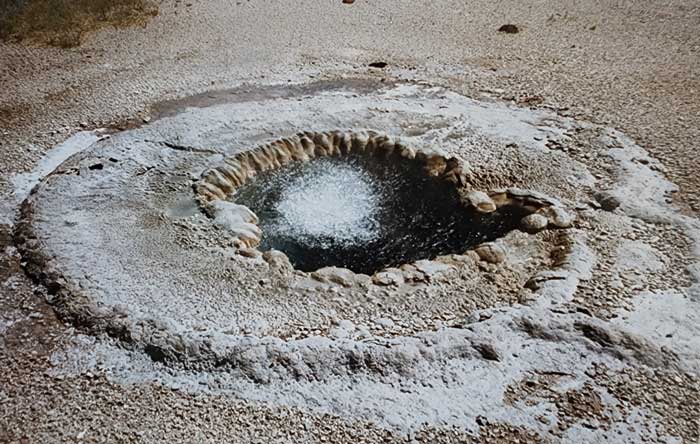
Erupting geysers and bubbling, boiling water springs
The park has a huge number (about 10,000!!) of geysers and steaming pools, including bubbling mud pools. The most famous geyser of all is: "Old Faithful Geyser," a giant geyser that erupts once every 60 minutes. It is one of the largest geysers in the park, and at the peak of its eruption, its water jet reaches a height of tens of meters.
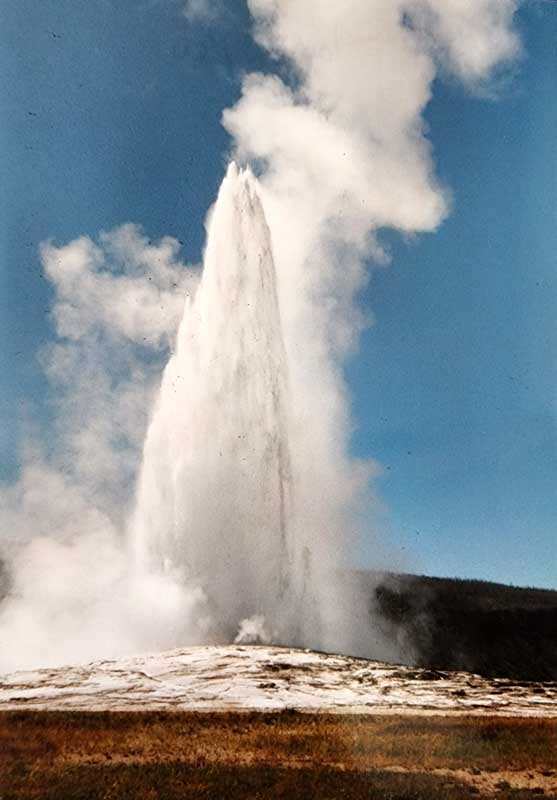
A board notifying the time of the next eruption is available to visitors. More than half an hour before the eruption time, hundreds of visitors crowd on the benches placed around the geyser at a safe distance from the source of the eruption. Near the Old Faithful Geyser, there is a circular walking path passing among other geysers and hot springs. It is highly recommended to walk this path instead of sitting on the benches and waiting for the eruption. Other geysers are less famous because they erupt less frequently or the intensity of the eruption is weaker. A bad smell of sulfur emanates from the geysers and springs. For those whom the smell makes feel unwell, it is recommended to move away from the geysers, breathe fresh air, and then continue the tour path.
Areas where you can tour among many springs and geysers on comfortable walking paths are: West Thumb, Norris, and the vicinity of Old Faithful Geyser. There is a strict prohibition on leaving the paths and approaching the springs or geysers! The ground around them is unstable and could collapse. Keep a close watch on your children!
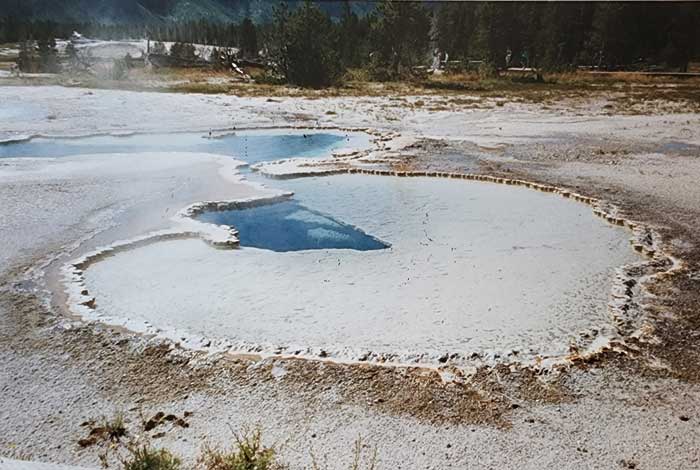
Near West Thumb, you will find a site called "Paintpot," which has dozens of hot springs whose edges are colored by algae in a spectacular variety of colors. Must not be missed!
Near Fishing Bridge, at Mud Volcano, there is a high concentration of bubbling mud and sulfur pools (which emit a bad smell) in a variety of sizes and shapes. The noise of the mud flow in one of the caves resembles dragon grunts, so it is called "Dragon's Mouth."
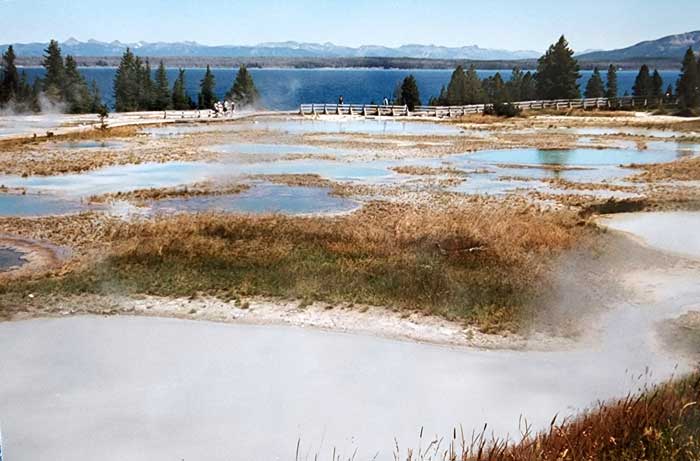
On the way between Old Faithful Geyser and Norris, there are many walking paths among geysers and water pools, but there is absolutely no need to stop at all of them, as the sight repeats itself (at least in the eyes of children) and there is no need to make such a unique and interesting phenomenon tedious for them.
Grand Canyon of the Yellowstone
Located between Canyon and Tower-Roosevelt.
This is one of the most spectacular areas in Yellowstone! From several viewpoints, there is an impressive view of the Yellowstone River winding in a deep gorge among high cliffs. Some of the viewpoints overlook from different angles one of the two waterfalls: the Upper Falls and the Lower Falls. Comfortable and short walking paths lead to the viewpoints. The most recommended viewpoints are: "Artist’s Point" on the south side of the canyon and "Inspiration Point" on its north side. The most beautiful view of the Lower Falls is from Lookout Point.
A fairly steep path called "Uncle Tom’s Trail," about a kilometer long, leads to the top of the waterfall (about halfway to the canyon floor). The amazing view and proximity to the waterfall justify the relatively steep climb awaiting you on the way back.

Mammoth Hot Springs
Located near the northern entrance of the park. They are different in character and shape from other springs scattered in the park and it is very recommended to visit them. The springs are rich in various minerals that are slowly secreted from the water during the evaporation process, creating steps (terraces) that grow slowly one on top of the other. A spectacular sight of steps in a variety of shades is obtained: white, pink, orange, yellow, and brown covered by the steam of the hot springs.

Well-marked trails allow visitors to tour safely among the steps and watch their formation up close. Do not leave the trails because in some places the ground is thin and could collapse! A one-way road for cars surrounds the upper terrace, so if you are tired of walking, you can simply observe the unique phenomenon from the car.
Yellowstone Lake:
The lake is located at an altitude of about 2,600 meters above sea level and is the largest lake in North America at such a high altitude. Its area: 350 sq km and its shoreline length: 176 km. The lake is frozen for about half a year from late December to late May or early June, and even during the rest of the year, its waters are too cold for swimming. The main activity at the lake is boating or fishing. The lake is located east and south of the road passing between West Thumb and Fishing Bridge.
Besides the natural wonders I have described so far, there is much more to see in Yellowstone: fossil trees, waterfalls, rivers, forests, and antiquities.
In addition to hiking and car tours, you can participate in many enjoyable activities in the park suitable for the whole family:
A carriage tour drawn by horses lasting 30-60 minutes and departing several times a day from the Tower-Roosevelt area. Further details by phone: 307-344-7311 or at the visitor centers scattered in the park.
Guided horseback riding on the park trails for an hour or two – riding tours depart throughout the day from Mammoth Hot Springs, Roosevelt, and Canyon. For exact details, check at the visitor centers.
Boating on the lake: Motorboats and rowboats can be rented on Yellowstone Lake from a marina named Bridge Bay.
Activity guided by the Rangers: In the park, there are plenty of activities provided free of charge by the Rangers, including guided hikes, lectures, slides, and many more activities especially suitable for children.
Swimming: Although the park is full of lakes, springs, and rivers, the only place suitable for swimming is near the western entrance of the park, near the Madison junction. About halfway down a small one-way road for cars called Firehole Canyon Drive, there is a small section where the river flow is slower and it is suitable for bathing and wading. The water is quite cold, but most children will enjoy the opportunity to jump into the water on hot summer days. Especially recommended after a hike among the steaming geysers and hot springs.
Wildlife in the Park:
Yellowstone has an abundance of wildlife in a variety of sizes and types: ranging from bears, elk, deer, bison, goats, and wolves to small mammals such as raccoons and squirrels. These animals roam freely throughout the park.
During the busy tourist season, you will be lucky if you notice a bear because bears tend to stay away from crowded places, but in any season you will meet entire herds of elk or bison grazing peacefully and contentedly, even resting in the shadow of the visitor center. Do not approach the animals! Photograph them from a distance and do not feed them or try to touch them. Beyond the personal danger involved, remember that all animals in the park are protected and the park authorities strictly maintain the laws protecting them. If you eat in nature, on a picnic or at a campsite, make sure to lock and hide your food products well and discard food remains only in trash containers that close tightly. Otherwise, uninvited guests might join your meal. Bears that get used to obtaining their food from hikers will eventually be killed, as they endanger hikers.
Water and land birds of many types stay in the park. Some permanently and some as part of their migration route.
Additional detailed information on Yellowstone and all interesting destinations in the USA is in my book: "United States for Families" by Sigalit Bar.
Detailed trip planning by Sigalit Bar, owner of the site and author of 5 travel guides.