Trip to the Grand Canyon National Park
♦ Routes (free): Detailed travel itineraries in USA
The "Grand Canyon" is the most famous canyon in the world and is considered one of the wonders of the world. The rushing Colorado River flowing in its channel is what carved through the rocky plateau and created this amazing and vast geological phenomenon. The width of the canyon between its two rims ranges from 6.5 km to 22 km, and its depth is 1,600 meters from the South Rim and 1,900 (!) meters from the North Rim. The North Rim is higher: 2,680 meters above sea level compared to 2,100 meters at the South Rim. The length of the fissure is 443 km, but only a relatively small section is visible from the observation points in the National Park. In any case, the park is located in the most impressive and breathtaking area. Part of the canyon's uniqueness stems from the fact that its colorful layers, which were formed one on top of the other over tens of millions of years, are exposed to the eye of the observer looking from above. From the opening of the canyon to its bottom, six (out of seven) vegetation zones of the northern hemisphere can be found.

The Grand Canyon serves as a natural museum for the history of the Earth.

Every year, over 5 million visitors arrive at the park! During the summer months, expect heavy crowds, traffic jams, and parking problems. The least crowded months in the park are November to February, during which the weather is cold and snowy. The South Rim of the park is open to visitors all year round, 24 hours a day. The North Rim is closed to visitors from the end of October until mid-May due to weather conditions and roads blocked by snow.
Most visitors travel to the South Rim. The North Rim has fewer facilities and services for tourists, and access to it is less convenient, but because it is higher, the view from it is even more impressive.
Booking helicopter or plane flights over the Grand Canyon from GetYourGuide.com:

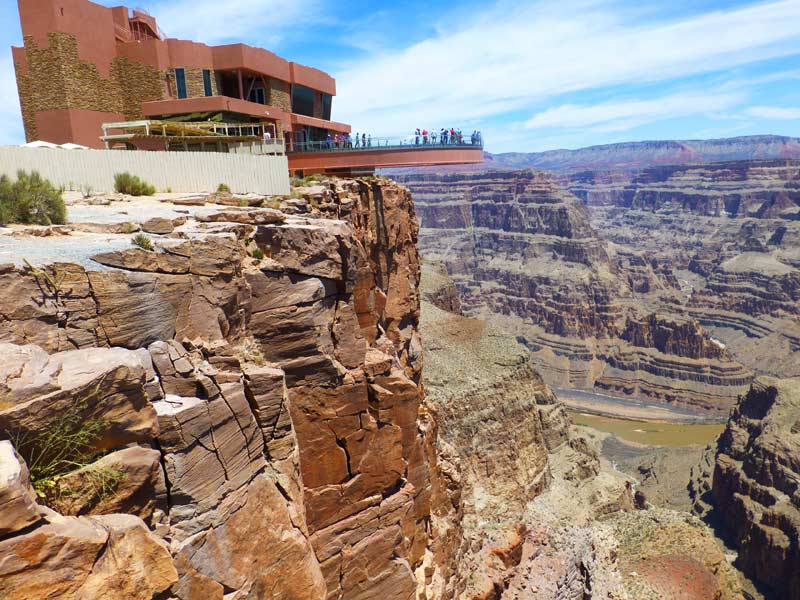
Observation deck - Skywalk:
A transparent glass walkway over a cliff at a height of 1,200 meters is located outside the National Park in the West Grand Canyon (Grand Canyon West), about 400 km from the Grand Canyon visitor center. The attraction is part of an Indian reservation of the Hualapai tribe, who operate a lodge and several activities at the site, including helicopter flights, rafting, and more. Each of their activities and attractions involves a very substantial fee.
Park Location and Transportation:
The park is located in northern Arizona. The South Rim is about 100 km north of the I-40 highway and is reached from Williams via Route 64. The park is about 130 km northwest of Flagstaff via Route 180. Despite the relatively narrow gap between the two rims, the driving time between them is about four and a half hours because a large detour of about 340 km is required between them. The North Rim is about 70 km south of Jacob Lake (Arizona) and is reached via Route 67.
♦ Recommended accommodations in the Grand Canyon
It is recommended to stay at the entrance to the National Park in the town of Tusayan
The most recommended hotels are:
Best Western Premier Grand Canyon Squire
and Holiday Inn Express Grand Canyon
Airports in the Area
The main airports relatively close to the park are: Las Vegas (over 6 hours of driving to the park) and Phoenix (about 4 and a half hours of driving), but you can also fly to Flagstaff on smaller planes. Even the Grand Canyon itself has a small airport (located south of the park), reached by small planes with about 10 seats on flights from Las Vegas and Phoenix.
Shuttle Service in the Park
Inside the park, a free shuttle service operates between the observation points and the main facilities. The service operates from mid-March until mid-October.
There are two service lines: one on the West Rim of the canyon (West Rim Loop) and the second in the Canyon Village (Village Loop). Another bus line operates throughout the year, for a nominal fee, between Tusayan (the community adjacent to the park) and the South Rim.
Weather:
Since the South Rim is located at an altitude of about 2,100 meters above sea level, snow is expected in winter and even summer nights can be cool. In summer, the temperature drops from an average of 28 degrees Celsius during the day to an average of 11 degrees at night. At the higher North Rim, snow may fall for most of the year and the weather there is cooler. Inside the inner canyon (this information is important for active hikers descending into it), temperatures are much more extreme: in summer, the temperature reaches 40 degrees Celsius on many days. The weather is particularly volatile in spring and autumn, so you should bring clothes of all types and dress in layers.
Where to visit in the park:
Before you begin your tour of the Grand Canyon, it is highly recommended to see an IMAX film about the park projected on a giant screen. The film features beautiful photographs of the canyon from many unique angles (which you cannot see in a regular visit), a description of the park's formation, how it was discovered, and footage of brave adventurers who traveled in it and sailed on the turbulent Colorado River. Amazing photographs and interesting explanations. Immediately upon entering the park, go to the visitor center for maps and information and for a short viewing of the permanent display there. The Grand Canyon can be seen from the rim of the cliff from several observation points along the East Rim Drive, which is 42 km long between the "Village" and the furthest point called: "Desert View". Excellent observation points are also located on the West Rim Drive, which is 14.5 km long. From the end of May until the beginning of September, these roads are closed to private cars (due to the influx of visitors) and you can travel between the observation points by the service bus (free). The view from the observation points is stunning and inconceivable. From each observation point, the viewing angle is slightly different: from some you can see the Colorado River winding at the bottom of the canyon and from some you see only an endless view of cliffs. There is no need to stop at every observation point because after several points you will find that even this ancient and amazing landscape repeats itself and children's patience may wear thin.
Warning note:
At most observation points there is no fence (or the fence is low) in order not to spoil the view. Do not let your children approach the edge of the cliff; make sure they are close to you.

In addition to scenic views, you can visit a point called: Tusayan where there is a small museum and ruins of an ancient Indian village. Do not skip the "Desert View" point where there is an ancient Indian watchtower that you can climb to the top of, observe the view, and look at the interesting paintings on its ceiling and walls.
Helicopter Tours
You will get a special experience with helicopter tours departing from Las Vegas. Below is a variety of fascinating tours to book from Viator:
Rangers Tours
The Rangers organize a wide variety of programs for park visitors throughout the year, including evening programs (in closed buildings during winter nights and in open structures in summer). Details of the activities and additional information can be obtained at the visitor center and in the park newspaper distributed for free at the park entrance.

Hiking Trails
Unlike most parks which have many trails for walking at different difficulty levels, the hiking trails in the Grand Canyon are quite difficult and are intended for those in high physical fitness due to their steepness. The only trail suitable for families is the "Rim Trail" which can be toured from various points and in selected sections.
Mule Tours
From the rim of the canyon, mule tours depart to the bottom of the canyon. These tours are also not recommended for children or for people who are not in good physical condition.