Antarctica Cruise onboard the Ship Seabourn Pursuit
♦ Routes (free): Detailed travel itineraries in USA
Introduction
An Antarctica cruise is an exceptional experience in the cruise industry, which has been flourishing in recent years. Not many undertake it, partly due to its expensive price, the long flights, and concerns about the cold weather. There is a variety of ships that sail to Antarctica and a range of prices to match. The ships to Antarctica are much smaller than the large cruise ships that carry thousands of passengers. In ships to Antarctica, we are talking about up to 250 passengers on board. A difference of more than an order of magnitude. There are small, older ships with small rooms and minimal service, and there are larger, newer ships with luxurious suites and excellent service, such as the new Seabourn Pursuit (launched in 2023), which carried about 250 passengers with approximately 240 crew members! On this ship, we had the recommended and experiential voyage to Antarctica that will be detailed in this article.

The duration of the cruise is 10 nights, including 4 sea days (two at the beginning and two at the end) and 5 days in Antarctica.

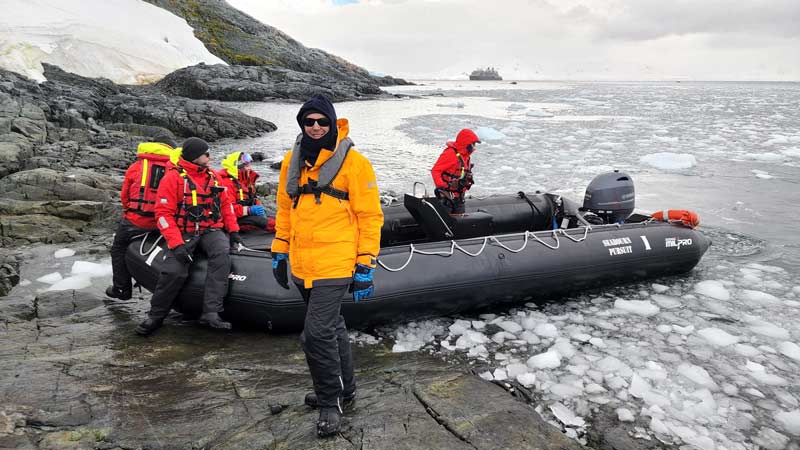
The cruise, the service on the ship, the food, and most importantly, the excursions in the destinations (about ten destinations) were all beyond expectations. At every location where the ship stopped, all passengers (who were divided into different time groups) usually disembarked twice at each site in rubber boats for a tour among magnificent glaciers and marine life, various types of penguins, seals, whales, and different birds.

Some excursions included walking and some were just scenic boating. All these excursions were included in the cruise price. Kayaking can also be booked at each destination for an additional (expensive) fee.

The ship also has two submarines for six passengers each, which can also dive to depths of hundreds of meters for an additional (expensive) fee. In Antarctica, the ship passes very close to giant glaciers both on land and glaciers that have detached from land and float with the wind and current.
This cruise is a wonderful and recommended experience!
How do you get to the cruise? Where does it start?
The cruise starts at the port of Ushuaia in southern Argentina, South America. This is the southernmost city in the world.
You fly to Buenos Aires and from there to Ushuaia.

The price of a Seabourn cruise includes a transfer from Buenos Aires airport to a 5-star hotel for one night in the city, and the following day, a transfer from the hotel to the airport and a flight to Ushuaia (included in the price), and from the field, a transfer to the ship, as well as the flight back to Buenos Aires after the cruise.
Ship Description and Facilities
Although it is a relatively small ship with only about 250 passengers, it is well-equipped with all means and comforts to make the stay pleasant for guests.
It has many public spaces both for entertainment inside the ship and for viewing the outdoor scenery. It has restaurants, bars, a pool and jacuzzis, a spa, sauna, gym, and a spacious theater hall, although there are no Broadway or Las Vegas-style shows and no casino. The rooms are spacious, with a large balcony and spacious bathrooms.


Room service with cleaning twice a day. There is also a free self-service laundry (including detergents) and a small shop.

Restaurants and Bars
In all restaurants and bars, various soft drinks are included, as well as white and red wine, with a specific type featured each day. Those who want a different wine or another alcoholic beverage can do so for an additional fee. Juices are also available, of course, including fresh-squeezed orange juice, which is included.
The Restaurant – Deck 4
This is the main and largest restaurant on the ship, open for breakfast, lunch, and dinner. It has a standard menu and a rotating menu. The food is very tasty and high-quality, and the service is exceptional. The desserts are also high-quality; almost every day there is a different type of souffle, a cheese platter, premium ice creams, fruit, and more.
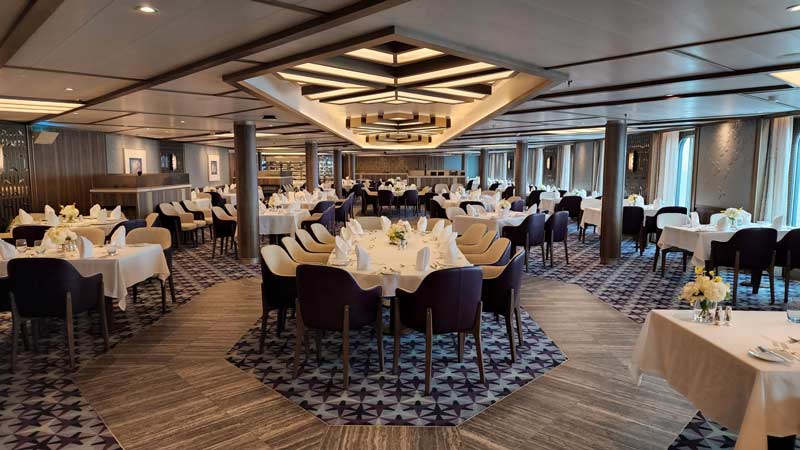
You can arrive for a meal whenever you want during opening hours and ask for a private table for two or more.

Most passengers prefer to eat at the buffet rather than at the full-service restaurant. My preference is actually for the restaurant where you sit comfortably and choose from the menu what you want without having to get up each time to the buffet. Throughout most of the cruise, the restaurant was half-empty at lunch. In the evening it was quite full, but there was never a line to enter when we arrived; at most, we waited 2-3 minutes.


The Colonnade – Buffet on Deck 5
The Colonnade serves as a buffet in the morning, and for lunch and dinner, it functions as a restaurant with a full-service menu. In the morning, you can order eggs, various omelets, etc., served to the table. The buffet was particularly popular for lunch.


Seabourn Square – Cafeteria on Deck 6
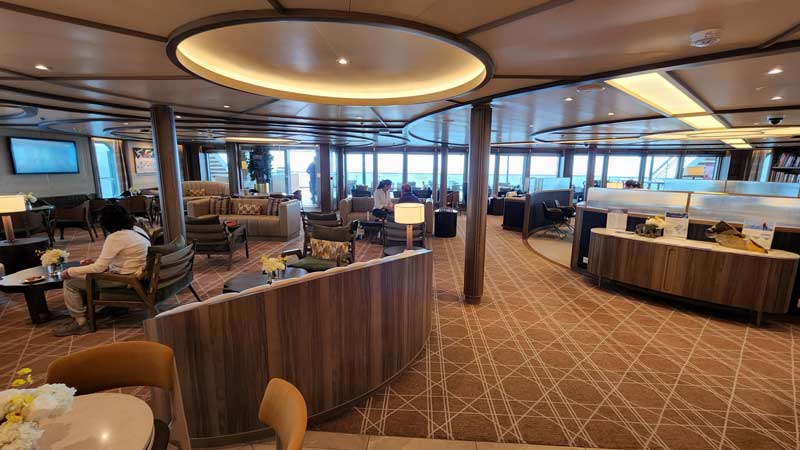
On Deck 6 aft, there is a cafeteria called Seabourn Square where they serve light breakfasts of fruit cups, yogurts, various pastries, and high-quality coffee of your choice. All included. During the day, various sandwiches are also served. Part of this hall also houses the Guest Services desks, which are staffed 24 hours a day.
Bow Lounge – Deck 6
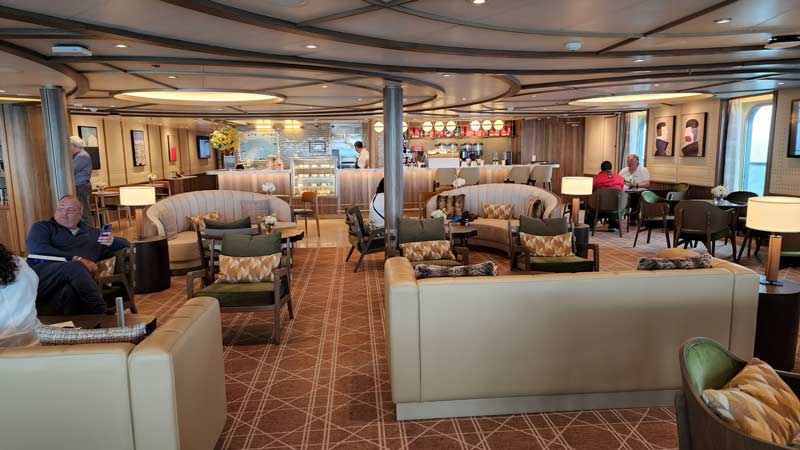
On Deck 6 forward is the Bow Lounge, which is a viewing area from the bow looking ahead and includes several screens identical to those on the bridge, where you can watch the ship's route on a map, screens with weather forecasts, wind, waves, precipitation, and more.

On both sides of the room, there are exits to the large forward deck. In the left corner of this room, there is a coffee station, a refrigerator with drinks, and various snacks.

This hall was very useful for viewing the scenery in Antarctica thanks to its panoramic windows overlooking spectacular glacier views during the voyage at various destinations.
Constellation Lounge – Deck 9
Also on Deck 9 forward is another lounge with panoramic windows overlooking the bow, which was also useful for viewing glaciers.

The lounge is located one floor above the bridge and also has a bar and a piano. In this lounge, during sea days, a 4 o'clock tea is served with a basket of cookies, scones, and tasty snacks. At certain times, a pianist plays there.

The Club – Deck 9
On Deck 9 aft is a piano bar – The Club, where sushi is served in the evening. The place also has a bar and a piano. In the evening, a pianist played and sang in the club, and later a singer, who was also responsible for the entertainment crew, sang there.


Discovery Center – Deck 4 forward
This is the largest theater hall with enough seats for all passengers at once.

Mainly, daily briefings are held here for all passengers regarding the excursions for the following day. Numerous lectures on various nature topics were also held here by the professional expedition team, as well as various events and movies.
Expedition Lounge – Deck 4
In this lounge adjacent to the show hall, there is a bar and seating areas.

Spa and Gym
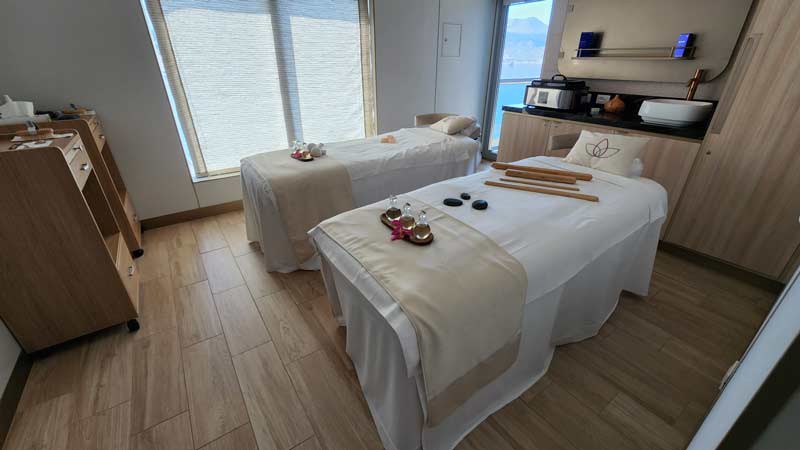
On Deck 7 aft is the spa with treatment rooms, a hair salon, sauna, and gym.


Pool and Jacuzzis
On Deck 5 aft is the pool (heated, of course) with two adjacent jacuzzis. On Deck 9 aft, there are two more jacuzzis.


Landing Zone – Deck 3
In the center of the ship on Deck 3 is the Landing Zone for the boats. This is where boots are put on and passengers board the rubber boats.

Ship's Bridge – Deck 8
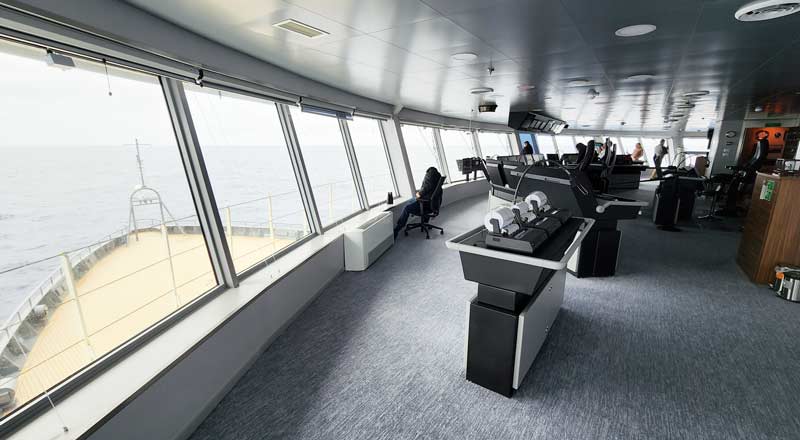
On Deck 8 is the ship's bridge and, surprisingly, it is open for free visits, where explanations of the bridge systems are given. In the daily newsletter (and app) detailing all activities, it states when the bridge is open for passengers to visit.

Service on the Ship
The service on the ship is outstanding, providing personal attention due to the small number of passengers and the large number of staff, some of whom know passengers by name. Rooms are tidied and cleaned twice a day, in the morning and evening. In the cafeteria on Deck 6, there is also the Guest Services which is staffed 24 hours a day.
The ship has about 240 crew members for about 250 passengers, an exceptionally high staff-to-passenger ratio, almost 1:1, compared to 1:4 or more on large cruise ships.
Briefings and Excursions
Every day, a briefing regarding the following day's activities is held in the main hall with slides and photos of the destination and route.
Daily information sheets are also distributed to the rooms detailing the activities for the next day.
At the beginning of the cruise, instructions are given on how to wear the gear for boat excursions, along with demonstrations on putting on a dry suit for kayaking and how to enter a kayak.
Passengers are divided into six color-coded groups (there is a color sticker on the room card). Disembarkation to the boats takes place at three different times in the morning and afternoon. At each disembarkation, two groups go out and return after about an hour and fifteen minutes, and then the next two groups go out, so all passengers manage to go out on the boats once in the morning and once in the afternoon, each time to a different place and activity for about an hour and fifteen minutes per outing.
Specific times are also set for the submarine and kayaks in the morning and afternoon. Anyone going on the submarine or kayaks whose scheduled color group excursion overlaps can join another color group.
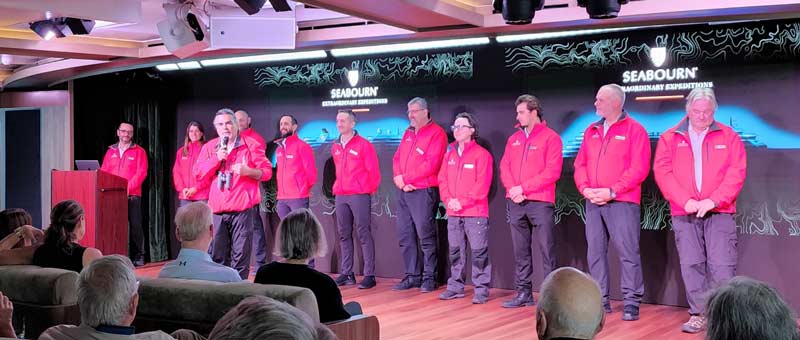
Everything is perfectly timed. The "Expedition Team" that organizes and guides the excursions is professional and experienced, and the guides are full of knowledge and provide explanations both during and before the tours.
Part of the guiding and excursion team:
Seabourn App - Source
This app provides the daily information sheet with all activities. It also contains information on restaurants and menus. It has a map with a description of all sections of the ship on each deck. It also shows the personal activities booked. There is also an ongoing balance of expenses, other personal details, and options to order internet and other information. A very useful and essential app for passengers.
Internet on the Ship
The cruise price includes a basic internet package. Those interested can upgrade to a streaming package (Netflix, etc.) for about $200 for four devices. The basic package is very good; you can browse well, even on Facebook (though not videos) and Instagram, as well as WhatsApp video calls. YouTube and Dropbox do not work on the basic package.
Photography Studio and Cruise Documentation
The ship also has two photographers who take photos of the passengers during the excursions; they also have a drone for filming at various destinations. At the end of the trip, they provide a file with photos from the trip for free to whoever wants them (copied to a phone or memory card). They also prepare a lovely half-hour video of the trip (including drone footage) and screen it for all passengers in the main hall on the last day.
Documentation and Cruise Photos
Seabourn also has a website called Voyage Tracker, which is basically a travel diary for all their ships, where they write every day where the ship was and where they traveled, including photos of the destination. This is also where they upload the summary video of the voyage!
Description of the Voyage and Activities at Various Destinations in Antarctica
Boarding the Ship
Some passengers arrive early on the flight to Ushuaia, before 11:00 AM, so the transfer (by bus) from the field includes a tour of about an hour and a half in Ushuaia before arriving at the ship because rooms are not yet ready.
Ushuaia:

After the tour, the transfer arrives at the ship at about 12:30 PM. Boarding is quick, within minutes. Passengers can tour the city a bit more, and those who don't wish to can explore the ship, eat lunch, spend time in the pool and jacuzzi, and get settled in their rooms. At 5:00 PM, a safety briefing is held in the main hall, called the Discovery Center, followed by explanations regarding the excursions and the method of boarding the boats. Afterwards, a wonderful dinner is served.
Sailing to Antarctica
The first islands reached in Antarctica are about 900 km from the southern tip of South America. On this cruise, several islands and destinations in the northwestern part of the Antarctic Peninsula are visited.
Cruise itinerary map:

It is important to emphasize that the route changes depending on the weather and sea conditions. In the cruise itinerary prior to sailing, it only says "Antarctica" for five days, and only the evening before arrival at each destination is information given on the location and activities. The ship sails in the evening shortly after 7:00 PM from Ushuaia. About two sea days are required until reaching the edge of Antarctica. During these two days, the Drake Passage is crossed. This passage is known as one of the places where some of the strongest storms in the world occur. Fortunately, we had favorable weather and besides moderate swell that caused slight swaying, the crossing was relaxed. On the first sea day, boots were fitted for the passengers (excellent, loaned for free) to be used for disembarking to the boats and shore, and anyone who wanted to exchange the jackets they received (included in the price and yours to keep) for a better size did so. A waterproof backpack is also given as a gift. For those who booked kayaking (additional fee), a demonstration is held on how to move from the rubber boat to the kayak and how to position oneself inside. A demonstration is also held on how to put on the dry suit that kayakers wear (the suit is loaned and included in the kayak fee). No previous kayaking experience is necessary. A tour of the room where the submarines are stored is also held on this day; there are two. Each submarine has seven seats: 6 for passengers and one for the pilot. Diving in the submarine costs about a thousand dollars per person (this, understandably, is not included).

The upper part of the submarine when it's in the water:

Sailing and Arrival at Greenwich Island
On the second sea day (the third day of the cruise), a stop is made near Greenwich Island in a bay called Yankee Harbour, which has a large colony of Gentoo penguins, fur seals, and elephant seals.

Boats were lowered into the water with the intention of taking us ashore for a tour, but there was a rather strong wind and the sea was choppy, so the tour was canceled. Instead, we spent time in the jacuzzi.

Video of arrival at Greenwich Island:
Continuing to Deception Island, which is a volcanic crater that was flooded by seawater after it erupted. The crater has an entrance on its southern side and the ship enters the crater, which is well protected from waves; next to us was also a large sailing ship.
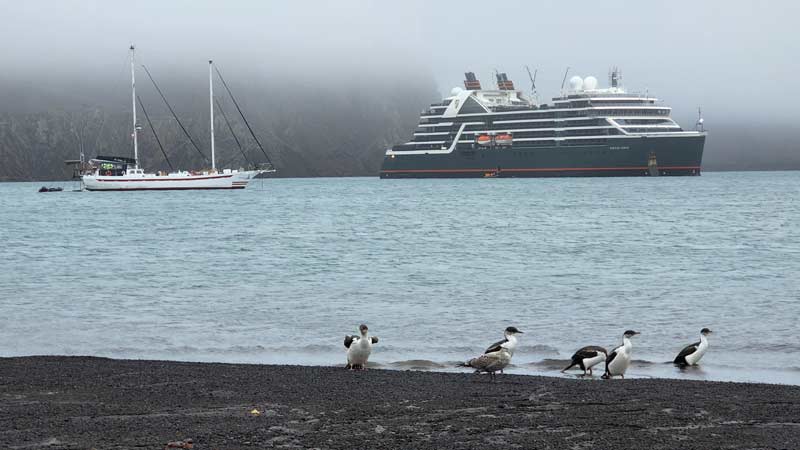
Note: At all locations where stops are made and boats are lowered, the ship does not drop anchor to stay in place, but uses its thrusters, which are operated constantly to maintain the ship's fixed position. Although this consumes fuel, it saves time because upon arrival, the rubber boats are immediately lowered and activity begins without having to wait for the process of dropping anchor and the ship stabilizing in its position.
Trip to Deception Island
On the fourth day, passengers go ashore in two separate tours by rubber boats to two different locations on the volcanic island. The first location is called Whalers Bay.
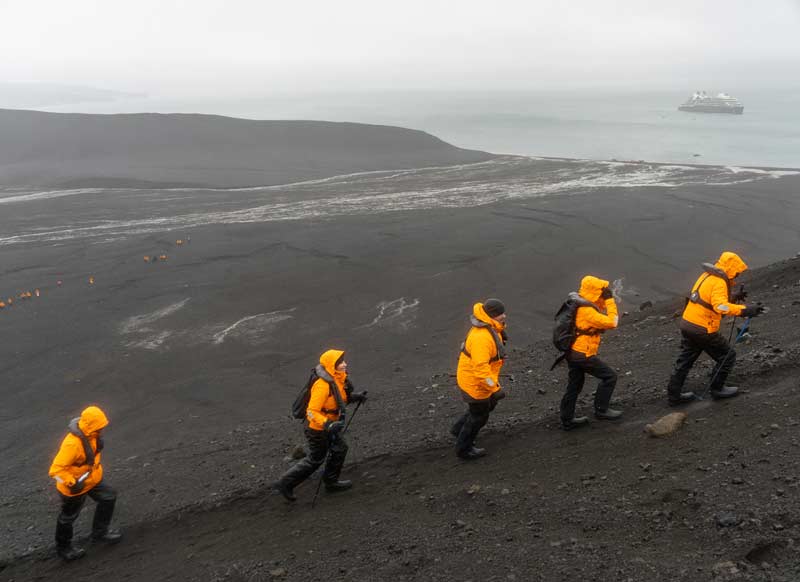
Disembarking by boats to the shore where there is a 4.3 km hiking trail that includes a walk up a hill to an elevation of about 200 meters to view an impressive volcanic crater and the view of the bay where the ship is located.
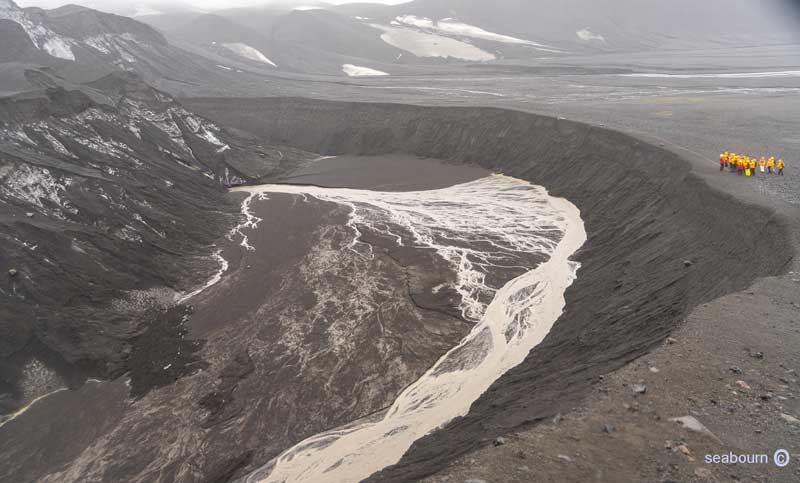
Video of a trip to Telefon Bay:
From there, the ship moves to another location near the entrance to the crater at a bay called Whalers Bay. The place was formerly used by whale hunters between 1911 and 1931. Subsequently, from 1944 to 1969, it served as a research base. In 1969, it was finally abandoned due to a volcanic eruption. The site has giant whale oil storage tanks, boilers, various buildings, and a plane hangar. Everything is in a state of decay.

Disembarking by boats to the shore where a thermal phenomenon is witnessed – steam rising from the warm ground due to underground thermal activity.

Touring the site among the various buildings without entering them due to risk of collapse.
Along the shore, many fur seals sprawl, a lone penguin, and a variety of bird species. The walking trail is on volcanic soil, not on snow or ice.

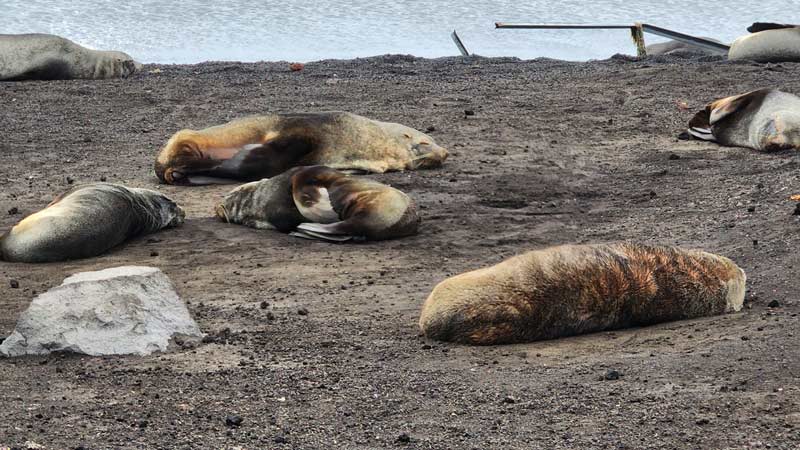
Each tour on this day lasts about an hour and a half for each group.
Here too, some passengers went on a submarine tour to the depths of the crater.
The temperature is around zero degrees Celsius, but thanks to appropriate clothing and good boots, the cold is not felt.
Each time passengers return to the ship, hot cocoa with a choice of liqueur and whipped cream for those who want it awaits them.
It's fun and pampering after the tour to thaw in the jacuzzi while watching the dramatic scenery.
Video of the trip to Whalers Bay:
Portal Point and Cierva Cove
The next day (the fifth), arrival at a site called Portal Point. Disembarking there by boats to the shore for a tour of about an hour. Climbing a snowy hill, surrounded by glacier and snow scenery; crabeater seals are in the area. A total of about two km of easy walking on the snow. It is advisable to use walking sticks; for those who do not have their own, the ship provides them.


Video of the trip to Portal Point:
Kayaking
Immediately after this tour, return to the ship and prepare for kayaking (for those who booked) among the glaciers. The kayaking fee is not included and costs $200 per person.
For this outing, a dry suit is provided from foot to neck. A different life jacket than the one used for boat outings is also given. Regarding clothing, the outer layer—the orange parka and waterproof pants—is removed, and the dry suit is worn over thick pants and a sweater.

A boat takes you to the area where the kayaking begins and you move directly from the boat into the kayak. Paddling in a line behind the guide, passing near glaciers and approaching the shore where many seals are seen. The kayak is comfortable for sitting (up to a height of 193 cm; taller individuals sit in the back). A total of an hour and a quarter is spent in the kayak itself.

Video of kayaking:
Whale Watching
In the bay where the ship was stationed, there were several pods of Humpback whales that surfaced while making loud sounds, spraying water spouts, and waving their tails upon diving. On one occasion, we watched three tails diving together side by side.

Cierva Cove
From there, the ship sails north about 3 hours, approximately 33 km, to a place called Cierva Cove and stands there near an active research base called Primavera Base.

Disembarking by rubber boats for a tour among glaciers and islands to view glaciers and colonies of Chinstrap and Gentoo penguins on the islands.

During the boating, groups of penguins can be seen jumping rapidly out of the water.
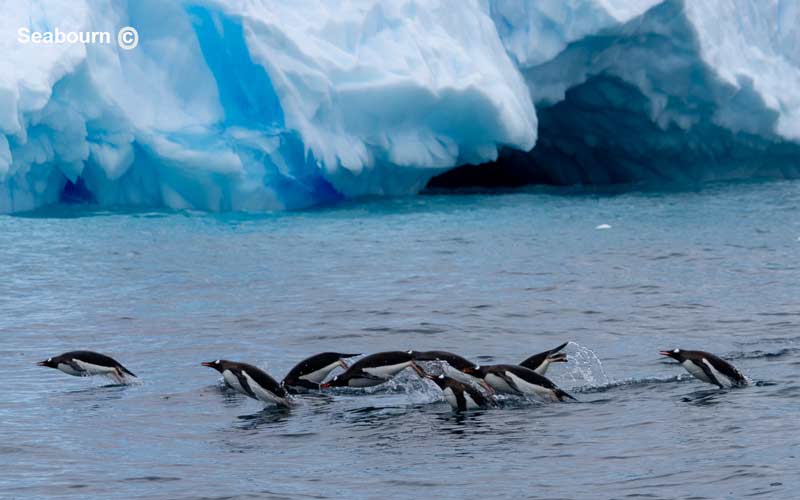
On the shore are large colonies of penguins and a sharp scent of their guano fills the clear sea air.
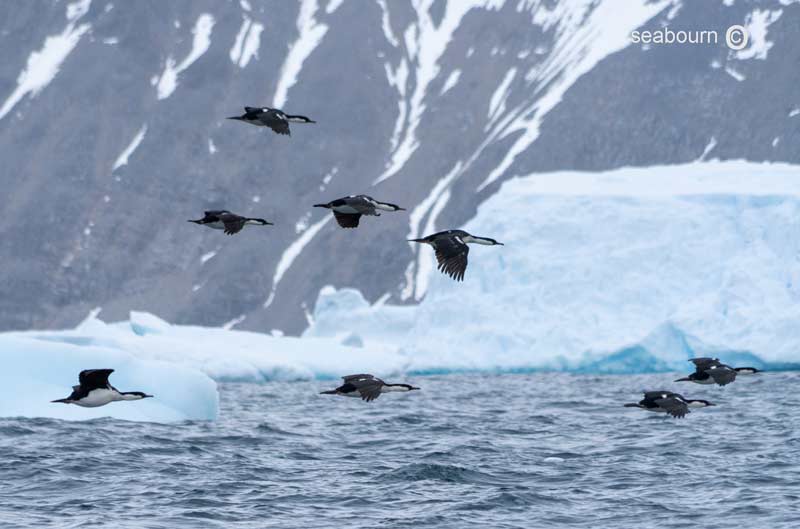
Video of boating in Cierva Cove:
From here, continuing east to the next destination at Two Hummock Island; on the way, various glaciers and sometimes whales can be spotted.
Palaver Point and Davis Island, Palmer Archipelago
On the morning of the sixth day of the trip, disembarking to boats and sailing to the shore at Two Hummock Island in the Palmer Archipelago island chain. Here, a hike of about two km on the snow is taken, climbing to an elevation of about 150 meters.
Palaver Point
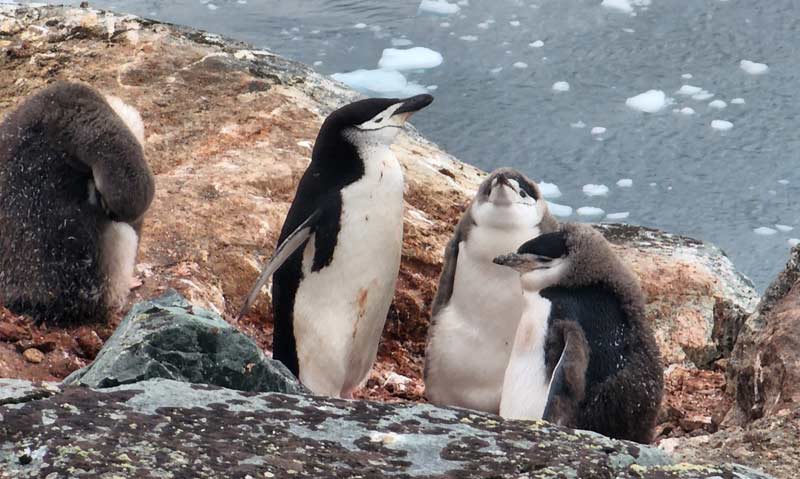
Along the trail are colonies of many Chinstrap penguins and surrounded by beautiful views of glaciers in the water and snowy mountains.
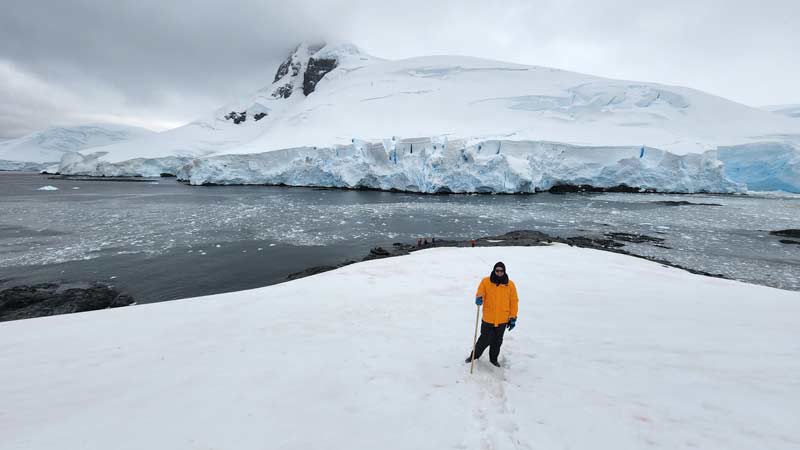
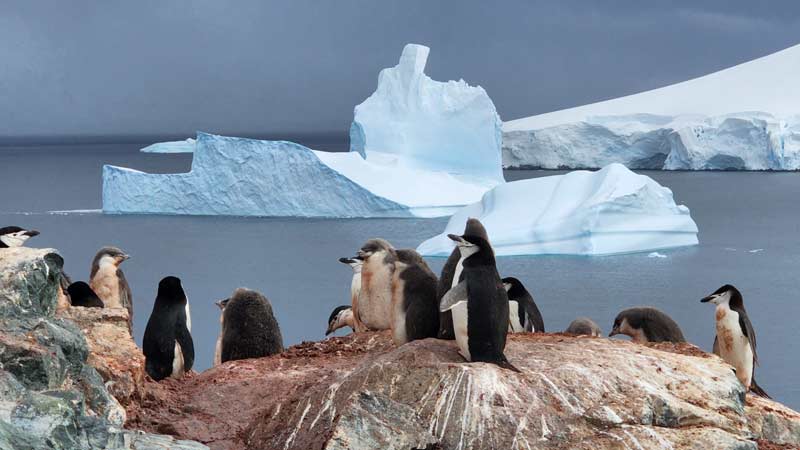
Along the way, penguins are observed returning from the sea with food for their two-month-old chicks, which have already reached nearly the same size as their parents. There are also Skuas at the site which attack penguin chicks and eggs during nesting season.
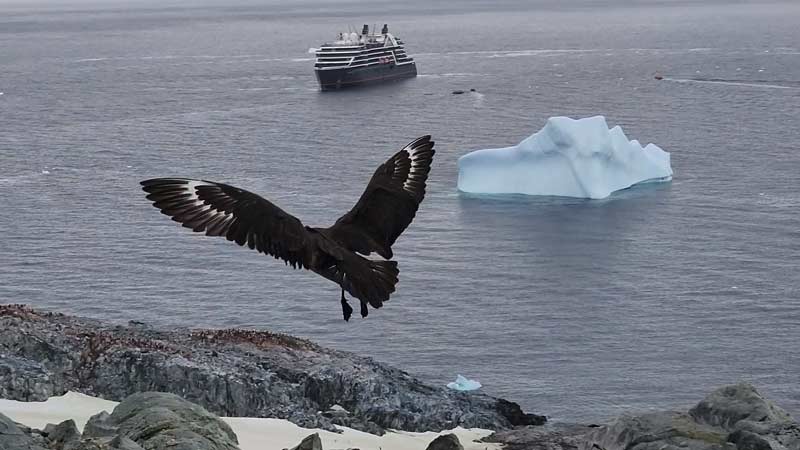
Near the landing point on the shore, the thunder of glacier collapses is occasionally heard, and once there was a major collapse of a large section of the glacier into the water.
Video of the trip to Palaver Point:
Boating among glaciers near Davis Island
In the afternoon, the ship sails west about 8 nautical miles to another island in this chain called Davis Island, and there among the islands, disembarking again to rubber boats for a scenic tour without going ashore.

The boating is enchanting, sailing through a giant field of large glaciers in magnificent shapes. An amazing sight. The adjacent island was high, a very steep cliff.


Video of boating among glaciers at Davis Island:
After the boating, sailing south 96 nautical miles to the next point adjacent to a research base named Vernadsky Research Base. Note: Due to sea and wind conditions, some of the kayak and submarine tours were canceled, but not the rubber boat and shore tours.
Port Charcot
At six in the morning on the seventh day of the trip, arrival at the destination entrance, sailing past a very high cliff and entering a quiet bay full of glaciers of various sizes to a place called Port Charcot on Booth Island, located not far from the Vernadsky Research Base. At 07:45, the first boats shuttle passengers to the shore at a bay called Francis Cove. Everything is snowy with patches of exposed rocks where many penguins are found.

There are two hiking trails at the site, one longer to a high viewpoint and the second shorter to large penguin colonies. There are also penguin colonies along the longer trail that are passed closely.

Midway through the trip on the long trail, heavy snow began to fall. Visibility was very limited at the top of the viewpoint because of the snow. The snow did not interfere with walking the planned route.


On the short route, you encounter penguins very closely, within a few meters, as they make their way from the sea to the rocks and back.
Video of the trip to Francis Cove:
Boating among Glaciers

In the afternoon, disembarking to boats for an hour and a half of boating among many glaciers in an adjacent bay called Pleneau Bay.

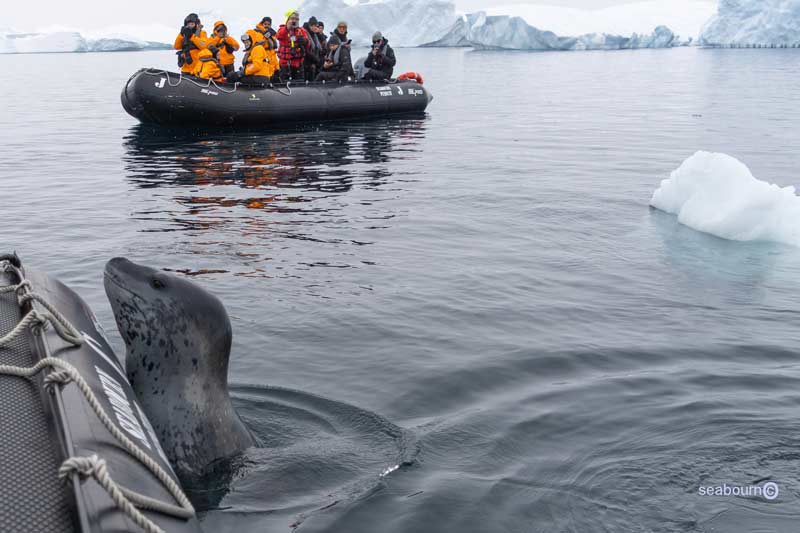
In this boating tour, seals and penguins are also encountered. On one of the smaller glaciers, a large Leopard seal was napping, receiving many photos from enthusiastic passengers.

Occasionally, groups of penguins jump from the water. They like to swim while jumping. At one of the stops among the glaciers, a large Leopard seal approached our boat and began circling it rapidly while jumping out of the water. Sometimes it also raised its head adjacent to the side of the boat to observe us closely, which caused much excitement among the passengers.

Video of boating among glaciers in Pleneau Bay:
Lemaire Channel
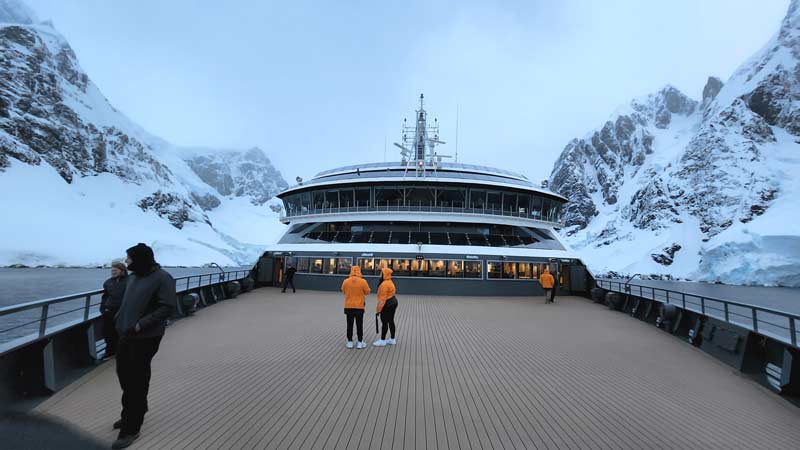
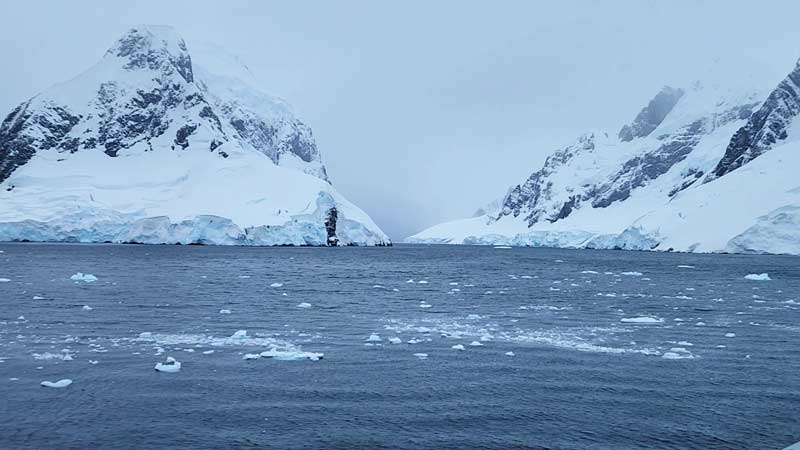
In the evening, we crossed north through the Lemaire Channel, which has high and steep cliffs on both sides. A very impressive sight.
Video of the crossing through Lemaire Channel:
Sailing north to Paradise Bay, located in the Southern Gerlache Strait.
Paradise Bay
On the morning of the eighth day of the cruise, the traditional Polar Plunge ceremony is performed, where passengers—those who are willing and brave, of course—jump into the freezing seawater! The temperature is 1 degree Celsius.

Video of the jump into the cold water:
Then sailing to a nearby location called Neko Harbor in Andvord Bay, where disembarking by boats for a shore tour. Paradise Bay also houses a Chilean base called Gonzales Videla Antarctic Base, which is surrounded by thousands of penguins.

Video of the Chilean Antarctic base:
Trip to Neko Harbor
The ship stands in a large bay strewn with glaciers near the shore. Surrounded by snowy mountains and glaciers. Disembarking to the shore in rubber boats sailing among glaciers. On the shore are many penguins, some entering and leaving the water.


On the shore, a hike is taken up a partially snowy hill strewn with penguins along its length. Here, many more opportunities are provided to see the colonies of penguins up close as they emit their constant calls. A sharp scent of their guano is in the air. From the top of the hill, there is a beautiful view of the entire snowy bay with the ship among the glaciers.

Boarding the boat back and essentially bidding farewell to the continent of Antarctica, as in the evening, sailing north back to Ushuaia.

Video of the trip to Neko Harbour:
Sailing back to Ushuaia
On the way back, there are two sea days crossing the Drake Passage again. During these days, enjoying the ship's facilities, bars, meals, and the spa—where not a single appointment for a massage was available during these days; everything was booked (it's important to book immediately upon boarding). Interesting lectures were also given on topics related to Antarctica—whales, penguins, glaciers, birds, and Antarctic geology—by the ship's Expedition Team. During sea days, passengers are pampered with tea at 4:00 PM with cookies, snacks, and musical accompaniment by a pianist. There is also a performance by a singer in the evening.

It is also time to do laundry... Also on the way back, the weather was favorable, with slight swaying due to moderate swell. Arriving in Ushuaia in the evening so it's possible to spend time there, and the following day passengers are transferred to the field and flown to Buenos Aires (all included in the cruise price).
Video of the view from the plane before landing in Ushuaia:
Note: Passengers in a wide age range participated in the Antarctica cruise, from young men and women in their twenties to those in their eighties plus, including even a small child, aged 6. Everyone participated in almost all excursions. This cruise is definitely suitable for everyone and not just for avid hikers.