Niagara Falls Travel Guide
Routes: Detailed travel routes in the United States (Free)
Routes: Detailed travel routes in Canada (Free)
General
Niagara Falls consists of two massive waterfalls located on the Niagara River, which forms the border between New York State, USA, and Ontario, Canada.
The American Falls are located on the American side of the border and carry only about ten percent of all the water in the falls. Their height is 55 meters and width 330 meters. To the right of the American Falls is a smaller waterfall separated from the American Falls by natural forces, named: Bridal Veil Falls. Between the two parts of the American Falls lies Goat Island.
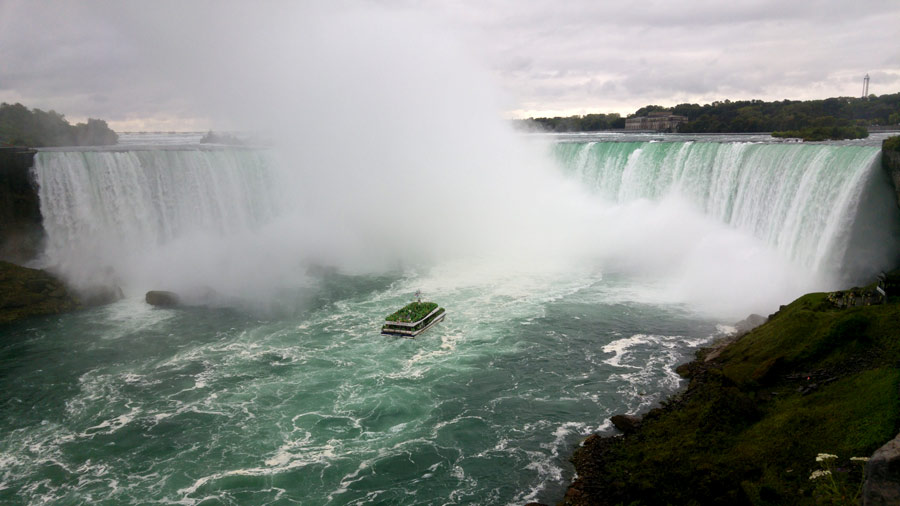
The Canadian falls are called the Horseshoe Falls and are located on the Canadian side of the border. Their height is 52 meters and width 750 meters. The massive volume of water flowing through the Horseshoe Falls gives them a green color.
The average depth of the water at the bottom of the falls is 52 meters, matching the depth of the water in the river.
Water reaches Niagara Falls from four of the five Great Lakes. From the falls, the water flows down the Niagara River, pours into Lake Ontario, from there along the St. Lawrence River, and finally into the Atlantic Ocean. The elevation difference between Lake Erie (which is the lake closest to the falls) and Lake Ontario into which the falls empty is 99 meters, with about half of the height difference caused by the falls themselves.
About 2,400 cubic meters of water flow through the falls every second on average (and over 6,000 cubic meters/second at peak season). Over half of it is utilized for electricity generation in the hydroelectric plants of the USA and Canada. Niagara Falls is currently the largest hydroelectric power generation source in the world.
The first hydroelectric plant (which was quite small and generated about 2,200 kilowatts) was established as early as 1893.
Today, several hydroelectric plants on the Canadian side generate almost 2 million kilowatts and two American plants generate an additional 2.4 million kilowatts, capable of providing electricity for 24 million 100-watt bulbs simultaneously!
There are no guided tours of the Canadian power stations, but there is a visitor center at one of the American plants: Robert Moses Niagara Power Plant.
The falls were formed 12,000 years ago, at the end of the last ice age, but their original location was 11.2 kilometers down the river from their current location. Over the years, erosion occurred on the waterfall's bank. There were years when the erosion rate (the movement of the bank) was 1.8 meters per year!
However, today due to control over flow intensity and the diversion of some water to the power stations, the erosion rate is significantly lower and is about 36 cm per ten years.
The major erosion in the rock results from the type of rock over which the falls flow. Although the upper layer is made of hard dolomite rocks, beneath it lie soft layers of sandstone and shale. The fierce water flow cut away the shale and soft sandstone until the hard dolomite layer collapsed due to lack of support. This type of erosion maintained the verticality of the wall over which the falls flow.
♦ Recommended accommodations for families in Niagara Falls on the Canadian side:
Since most popular tourist sites are located on the Canadian side of the falls, it is recommended to stay in the Canadian town of Niagara Falls, in order to be in the center of things and avoid frequent border crossings between the USA and Canada.
The most successful hotel for family stays, among the many attractions in Niagara with a wonderful view of the falls is:
Embassy
Suites Niagara Falls - Fallsview
This is a
suite hotel with apartments designed for spacious living for up to 6 people.
Nearby, another hotel with family suites overlooking the falls is:
Hilton
Hotel and Suites Niagara Falls/Fallsview
A cheaper suite hotel within a short walking distance is:
Days
Inn & Suites - Niagara Falls, Center St., By the
Fall
An even cheaper suite hotel located a 10-minute drive
from the falls is Blue Moon Motel:
Blue
Moon Motel
The hotel features two-bedroom and living room family suites suitable for up
to 6 people.
Recommended accommodations in Niagara Falls on the American side
3-star hotel in a location close to the falls and nearby attractions. Also suitable for families. Features parking, free Wi-Fi, and a fitness room.
3-star hotel located about one kilometer from the falls, also suitable for families. Indoor pool, free parking, free Wi-Fi, fitness room.
Seneca Niagara Resort & Casino
4-star casino resort located close to the falls, rooms for 2-4 guests, indoor pool, Jacuzzi, fitness center, restaurants, free parking and Wi-Fi.
5-star hotel located close to the falls. Also suitable for families. Paid parking available, free Wi-Fi.
Recommended hotels near Buffalo/Niagara Airport
Homewood Suites by Hilton Buffalo/Airport
3-star suite hotel with kitchen, breakfast included, also suitable for families, free airport shuttle. Indoor pool, fitness room, free Wi-Fi and parking.
Tru By Hilton Williamsville Buffalo Airport
3-star hotel, heated indoor pool, rooms also suitable for families, free airport shuttle. Free Wi-Fi and parking.
Hampton Inn Buffalo-Williamsville
3-star hotel also suitable for families, breakfast included, indoor pool, fitness room, free Wi-Fi and parking.
Search for a hotel on Booking on the Niagara Falls area map:
Booking.com
Important historical landmarks in the history of Niagara Falls:
1678: The Franciscan monk and explorer Louis Hennepin,
Louis Hennepin, arrives at the falls. He is the first European to arrive
in the area.
1846: Launch of the ship "Maid of the Mist" as a ferry between both
sides of the river.
1848: March: For the first time in recorded history,
the falls dried up due to strong westerly winds that kept water
in Lake Erie. Also, an ice jam blocked the river near Buffalo. People
in the area were happy to enter the dry river section and the edge of the falls, where they found,
among other discoveries, souvenirs from the war that took place in the area in 1812.
July: The first bridge over the Niagara River was inaugurated.
1859:
Jean
Francois Gravelet, known as the "Great Blondin," begins a series
of tightrope walks across the Niagara River in the whirlpool area,
about a kilometer and a half from the falls. His performances attract a crowd of about
25,000 people. He even carries his manager on his back in one of his performances.
1885: The Niagara Reservation State
Park is opened, drawing 750,000 visitors. This is the first state park
inaugurated in the USA.
Tourism:
The falls became a tourist site in 1820 and within 50 years the number
of tourists multiplied by 10 and the falls became the main industry in the area.
Niagara Falls is one of the most popular places in the world
to spend a honeymoon.
This custom began to develop in the mid-19th century
and strengthened even further in 1953 after the movie was filmed at the falls:
Niagara, starring Marilyn Monroe, who played
a young honeymooner in the film.
During the movie, her buttocks are exposed for two whole minutes while
she walked toward the falls to see them better.
The movie Superman 3 was also filmed at Niagara Falls.
The falls are known for many famous tourist attractions, such as: boat cruises on the "Maid of the Mist," Skylon and Minolta towers, Journey Behind the Falls, historical sites such as Fort George National Historic Site, many public parks, and even a large casino.
Main attractions at the falls:
Tours of Niagara Falls to book from GetYourGuide.com:
On the Canadian side:
Boat cruise to the falls
The original "Maid of the Mist" boat was already launched in 1846 as a ferry boat crossing the Niagara River below the falls. They carried passengers, mail, and cargo. The ship was quite bulky, but could carry a carriage and four horses. After the first suspension bridge over the river was established in 1848, the boats began to be used as tour boats, getting as close as possible to the falls, which continues to this day. This tourist trend flourished and prospered, and in 1854 the second ship was built. This is one of the oldest attractions in North America.
Since then, many ships have been built and "Maid of the Mist" is voted every year as the number one attraction of Niagara Falls. The ship has a double deck and can accommodate up to 600 passengers per trip. These ships departed from both the Canadian and American sides.
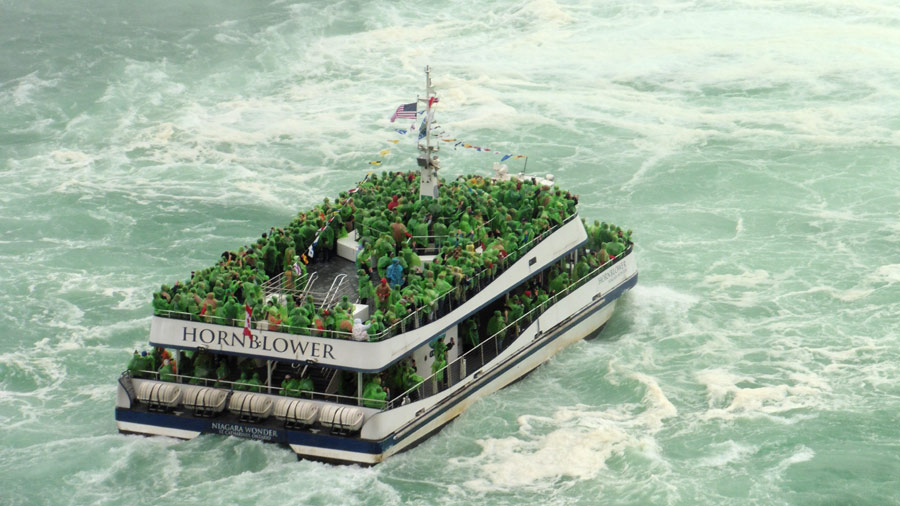
However, starting in 2014, the "Maid of the Mist" boat departs only from the American side and a new company named Hornblower won the tender for these tours from the Canadian side using modern catamaran boats accommodating up to 700 passengers each.
Booking popular tours from the Viator website:
On the Canadian side:
♦ Attractions at the falls on the Canadian side including an experiential boat cruise to the falls : Niagara Falls Canadian Adventure Tour
On the American side:
Booking a 4-5 hour tour from the Viator website called: All Niagara Falls USA Tour Maid of Mist Boat & So Much More
The boats depart every half hour from both sides of the river. They operate from May through October. Operating hours vary depending on the season. Cruise duration on the boats is about half an hour.
Upon boarding the boat, you receive a long rain jacket, because the cruise is
a quite wetting experience, but on the new boats
departing from the Canadian side, you can stay dry inside the enclosed
deck equipped with glass windows.
The
boats
sail to the base of the American Fall
and the Canadian Horseshoe Fall. It is amazing to hear the thunder of the falls and feel the spray
on your face. One of the many journalists who sailed on it wrote: "Until
you see Niagara Falls from the deck of the 'Maid of the Mist,' you do not understand
the immense power of the water."

In 155 years of existence, millions of tourists have sailed on the ship, including presidents, kings, and movie stars.
Gallery of important passengers on the "Maid of the Mist" over the years:
1860 - Prince of Wales (later became King Edward VII)
1901 - Theodore Roosevelt (later President of the USA)
1949 -
Prime Minister of India
1952 – Marilyn Monroe (participated in the movie
Niagara)
1983 – Canadian Prime Minister Pierre Trudeau
1983
– General Secretary of the Soviet Union Mikhail Gorbachev
1985
– President of China
Li Xiannian
1987 – Duke and Duchess of York, Prince Andrew
and Sarah Ferguson
1991 – Diana, Princess of Wales with her sons
Princes William and Harry
1996 – Former US President Jimmy
Carter and his wife.
Attractions on the American side:
The best viewpoint of the falls from the American side is Prospect Point. A kind of rock protrusion above which stands a tower rising 85 meters above the falls. From the top of the tower, there is a magnificent view of all the falls and it is open all year round. (In summer: 8-23 and in winter: 10-22). Admission is paid. Elevators descend from the tower to the gorge at water level, to the dock of the "Maid of the Mist" ferry.
You can take a tour on the "Maid of the Mist" boat, from the American side , from the base of the observation tower at Prospect Point. On the Canadian side, it is worth booking the following attractions: Attractions at the falls on the Canadian side including an experiential boat cruise to the falls:
Niagara Falls Canadian Adventure Tour

Goat Island is located between the two waterfalls. It can be reached by miniature trains or by walking on a footbridge. Elevators lead to the Cave of the Winds. Before entering the cave, you receive a hat, plastic coat, and special boots, and enter through underground tunnels to the falls (admission fee includes equipment usage). The tunnels lead for about 200 meters to observation platforms, where you see and feel the massive falls and see the colorful rainbow that is formed. Other tunnels lead behind the scenes of the water screen.
About three kilometers north of the falls is Whirlpool State Park, a bend in the river at a 90-degree angle with a park nearby, from which you can witness the spectacular sight of churning and rushing waters. 4 kilometers further is Power Vista, a visitor center for a massive power station.
River jet boat cruise
Booking the cruise from the reliable Viator website Niagara Falls Open Jet Boat Tour
A fast-paced cruise experience with views in the Niagara River gorge where the waters from the falls flow. The ship has an open deck for those wanting a wetting experience and also a closed deck for those wanting to stay dry. The ship sails into various rapids in the river and is equipped with a specially powerful engine for high speed and sharp turns. The cruise departs from Youngstown on the Niagara River about twenty km north of Niagara Falls on the American side. Cruise duration is about an hour.
Attractions on the Canadian side:
Since the Canadian side is more impressive and developed than the American side and since in the tour itinerary all the promised attractions are on this side, we will elaborate on it.
You can see the falls from every angle and every direction: from observation towers, from caves at the bottom of the waterfall, from boats, from a cable car, and from the top of the falls.
A unique experience is seeing the falls illuminated at night, as described by a Niagara visitor as early as 1940: "To see the falls at night is like being specially awake in a dream kingdom." The first attempt to illuminate the falls at night was as early as 1860, even before the use of electricity, in honor of the Prince of Wales' visit. Over the years, various techniques have been used to illuminate the falls and today 21 Xenon lamps are used to get the spectacular nighttime illumination. Each Xenon lamp is equivalent to 250,000,000 candles!
Every Friday evening at 10:30 PM from late May to late August, there are fireworks over the falls.
Cruise to the falls:
Of course, do not miss the cruise to the falls which I detailed earlier.
Welland Canal
The Welland Canal was established in 1829 to connect Lake Erie to Lake Ontario and give ships a passage bypassing Niagara Falls, effectively allowing large ships from all corners of the world to sail into the heart of the North American continent.
It is amazing to see how 30,000-ton ships rise and fall in such large elevation differences. But actually, the technology is very simple. Already 150 years ago, engineers discovered the trick: let gravity and water do the work. The locks (LOCK) are filled and emptied by water flowing from Lake Erie to Lake Ontario. Water flow is controlled by opening and closing gates.
Canal length: 45 km. Over the years, the canal underwent improvements and changes until reaching its final structure where there are eight massive locks raising and lowering ships with a total elevation difference of 99 meters. Even the largest ships can pass through this canal.
You can drive along the northern part of the canal on Government Street from Lake Ontario to Thorold, where the seventh lock is located. An excellent observation point is located at the third lock, where you can also find an information center describing the history of the canal.
Orchards and vineyards line the sides of the canal.
The phone number of the tourist site at Lock 3 and the museum: 905-688-5601 extension 1999.
Floral Clock:
This is one of the symbols of the city, known for its many gardens.
Built in
1950 inspired by the floral clock in Edinburgh, Scotland, and considered one
of the largest floral clocks in the world. Diameter: 12.2 meters. The flowers
in the clock are replaced twice a season. About 15,000
seedlings are planted in it each time. In spring, violets are planted in the clock. The clock was designed, planted
and maintained by the Niagara Park
Commission.
Near the clock is a garden with lilac flowers that blooms annually in late May.
The clock is located about 2.5 kilometers north of the Niagara Botanical Gardens.

Additional attractions:
Viewpoints of the falls:
On the Canadian side, two observation towers (paid):
Skylon Tower and the Minolta Tower.
The height of Skylon Tower is 235
meters and it is the taller of the two towers. The observation decks, one
outdoor and one indoor, are reached by glass elevators. At the top of the tower
is a revolving restaurant offering a magnificent view. Address: 5200
Robinson Street, Niagara Falls, ON.
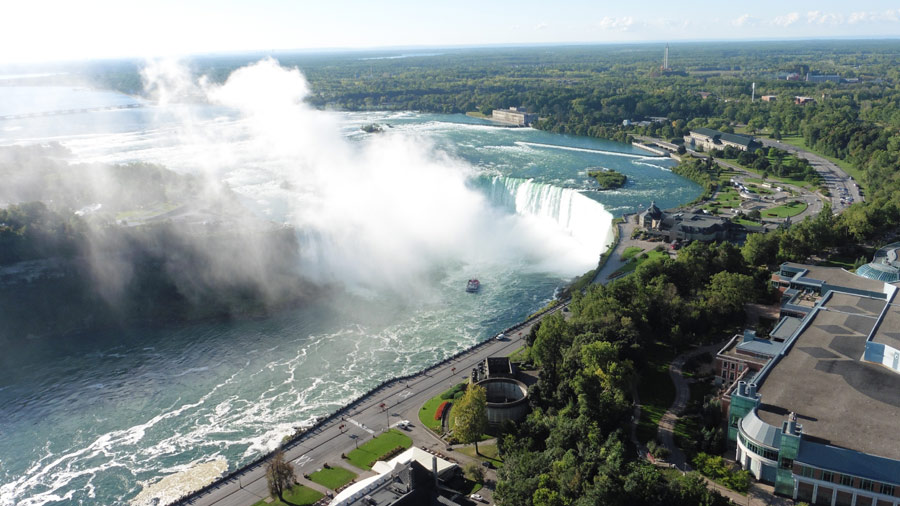
The Minolta Tower
is the older one, built in 1962 but recently renovated. Its height is about 160 meters and it has an indoor observation deck
and at the top of the tower a restaurant named: Pinnacle Restaurant. At the bottom
of the tower is a shopping complex. The tower is part of the Ramada
Plaza Fallsview hotel.
A particularly successful viewpoint is from the modern Ferris wheel
"Niagara SkyWheel," rising to a height
of 53 meters. Since it is located on a hill (Clifton
Hill), you can view the American,
Canadian falls, and the Niagara River. The ride duration in the wheel is about 12 minutes, during which
you will make about 6 rotations. Since the ride is in closed and air-conditioned cabins, the facility operates all year round.
"Rainbow Bridge" crosses the Niagara River and separates USA and Canada. It offers a panoramic view of the falls. On sunny days you can see a large rainbow through the spray of the waterfall water.

From the top of the Spanish Aero Car, Niagara Spanish Aero Car, a magnificent view of the Whirlpool rapids formed by a sharp turn in the river toward the northeast. The cable car is located 4.5 km down the river from the falls. The cable car is named after the Spanish engineer who designed and built it, Leonardo Torres Quevedo, and it has been operating since 1916. The cable car travels 76 meters above the river and is open between May and October.

More attractions
Another recommended attraction is "Journey Behind the Falls." You descend in elevators carved into the rock from the Table Rock House courtyard, passing through 46-meter-long tunnels to two unique observation points: one behind the Horseshoe Falls and the second beside the falls. The price includes raincoats for protection against the fierce water spray. Open all year round.
Great Gorge Adventure is another place where you can descend in elevators and tunnels to an observation platform, from which you can see the Whirlpool Rapids area. You can walk next to the stormy river on a boardwalk named Whitewater Boardwalk, which is 305 meters long. The elevators are located 3.2 km down the river from the falls.
Those who haven't gotten wet enough can try riding a high-speed motorboat named Whirlpool Jet sailing in the stormy waters of the Niagara River up to the especially stormy whirlpool area. Here too, of course, you receive raincoats but get thoroughly soaked.
A drier experience is watching a 3D IMAX movie on a huge screen 6 stories high depicting the heroic deeds of various people at the falls, disasters, and the wonders of the falls throughout history. Nearby is a small museum named The Daredevil Adventure featuring exhibits related to people who tried to cross the falls. Open all year round. Museum admission is included in the movie ticket.
A more expensive, but particularly impressive experience is a helicopter flight over the falls and river.
In addition to the many attractions related to the falls, there are many other tourist attractions nearby and of course many shopping and entertainment areas.
Clifton Hill is a colorful tourist area with abundance of attractions, such as: wax museums, Ripley's Believe It or Not museum displaying weird and amazing exhibits, Guinness World Records museum, family entertainment center named Dazzleland, minigolf, haunted house, Frankenstein's house, and of course plenty of restaurants and hotels.
Niagara Falls abounds with manicured gardens. In addition to the floral clock, it features botanical gardens, a butterfly park, and a charming park named Queen Victoria Park, which has free admission and a great view of the falls. The gardens bloom from early spring to late autumn.
Another family attraction is: Marineland. This is a huge aquarium with water animal shows combined with an amusement park featuring roller coasters and other rides.
Near Niagara Falls is a charming historic tourist town named Niagara-On-The-Lake. The town preserves the charm of the 19th century and features plenty of gardens, parks, forts, and artisan workshops.
Because of its strategic location, the town played an important role in the war that took place in the area in 1812. In fact, when you hear the history of this town, you understand the history of Ontario. This town hosts annually between April and October a prestigious performance festival featuring plays by George Bernard Shaw and other writers.
Helicopter tour over the falls
A magnificent helicopter flight experience over the falls. Departs from the Canadian side of the falls. Flight duration is about ten minutes.
Booking the aforementioned tour from the Viator website: Private Tour: Niagara Falls Helicopter Flight
Weather:
The coldest months in Niagara Falls are November to March, when the average temperature is: -6 to 4 degrees Celsius. Heavy snow falls during this period. April and October can also be cool and rainy. Summer months, June - August, are warm with temperatures of about 25 degrees Celsius during the day and 15 degrees at night. It should be taken into account that the falls affect local weather conditions with a "wet thermometer" effect. Even on a sunny and warm day, tourists staying close to the falls get quite wet from the heavy spray blown from them and may get soaked. Therefore, you should bring outerwear and especially it is advisable to equip yourself with a thin rain jacket.